

GLP-1 receptor agonists do more than lower blood sugar and reduce body weight. Clinical and molecular evidence now shows they directly modulate validated longevity markers, including epigenetic aging clocks, telomere length, and systemic inflammation, placing them among the most studied candidates in translational geroscience. Semaglutide, the most widely researched GLP-1 medication in aging biology, slowed biological aging by 9% as measured by the DunedinPACE epigenetic clock in a 2026 randomized, double-blind, placebo-controlled clinical trial published in Nature Communications. That same trial found telomere length increased in nearly 49% of participants.
Key longevity markers influenced by GLP-1 receptor agonists include:
- Epigenetic aging clocks (DunedinPACE, PCGrimAge): measurable slowing of biological age accumulation
- Telomere length: increased in nearly half of trial participants, linked to better physical function
- Inflammatory biomarkers: reduced high-sensitivity CRP by about 30%, a key driver of accelerated aging
- Cardiovascular mortality risk: significantly reduced via PCGrimAge clock measurements
- Mitochondrial function: improved cellular energy metabolism and oxidative stress resistance
- Metabolic homeostasis: modulation of insulin signaling, visceral fat, and nutrient-sensing pathways
Statistic callout: Semaglutide slowed the pace of biological aging by 9% on the DunedinPACE clock and increased telomere length in nearly 49% of participants, representing the first randomized controlled evidence that a GLP-1 drug influences human aging biology at the molecular level.
The science is still maturing, and most human evidence comes from metabolic disease populations. But the breadth of mechanisms involved, spanning cellular, organ, and systemic levels, gives researchers and clinicians reason to take GLP-1's longevity potential seriously.
How GLP-1 receptor activation shapes cellular aging biology
GLP-1 receptor agonists modulate all 12 hallmarks of aging identified in current geroscience, from mitochondrial dysfunction and chronic inflammation to impaired proteostasis and genomic instability. That breadth is unusual for a single drug class and explains why researchers are repositioning these medications beyond metabolic disease.
Core molecular mechanisms:
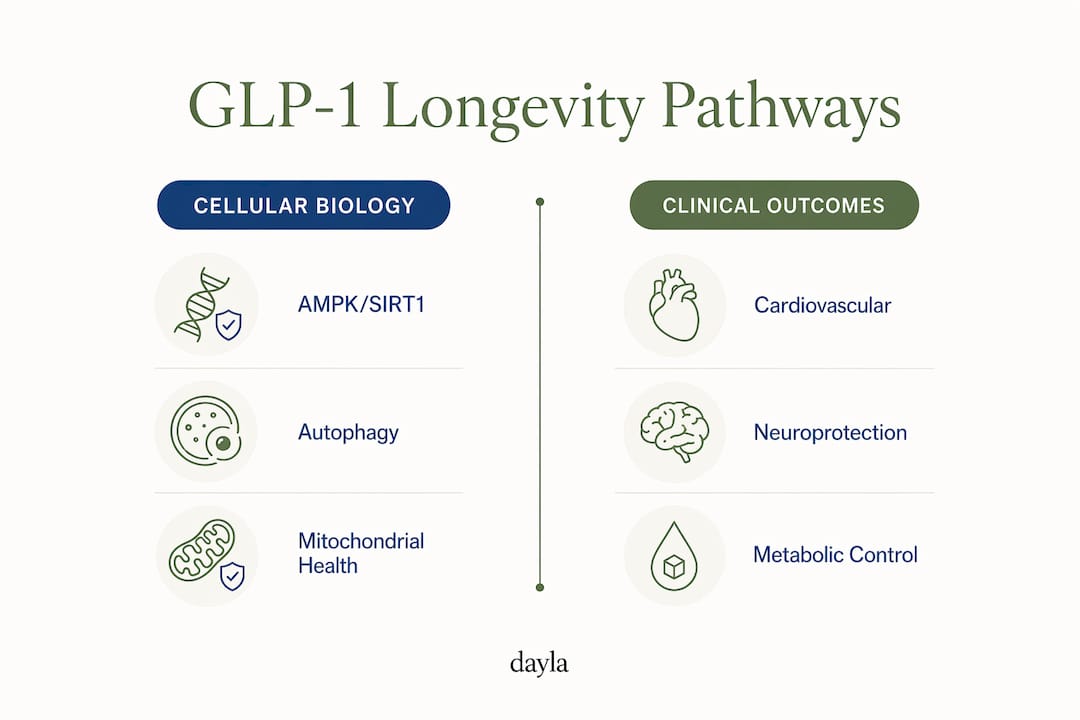
- Mitochondrial function: GLP-1 receptor activation improves mitochondrial biogenesis and reduces oxidative stress, protecting cells from the energy deficits that accumulate with age.
- Autophagy and proteostasis: Signaling through AMPK and SIRT1 upregulates autophagy, the cellular process that clears damaged proteins and organelles. mTOR suppression reinforces this effect, mirroring the anti-aging profile of rapamycin.
- NF-κB pathway suppression: GLP-1 RAs reduce NF-κB-mediated senescence-associated secretory phenotype (SASP) and PANoptosis pathways, directly dampening the chronic low-grade inflammation, often called "inflammaging," that drives tissue decline.
- Telomere integrity: GLP-1 receptor activation boosts telomerase expression and stabilizes mitochondrial metabolism, both of which protect telomere length and genomic stability.
- Gut microbiome: GLP-1 RAs improve gut microbiome diversity and barrier function, reducing systemic inflammation and mitigating age-related dysbiosis.
- Nutrient sensing: Modulation of Epac/PI3K/Akt, cAMP/PKA, and AMPK/SIRT1 signaling reprograms metabolic pathways that govern cellular lifespan.
| Pathway | GLP-1 Effect | Aging Relevance |
|---|---|---|
| AMPK/SIRT1 | Upregulated | Promotes autophagy, metabolic repair |
| mTOR | Suppressed | Slows cellular senescence |
| NF-κB/SASP | Inhibited | Reduces inflammaging and tissue decline |
| Mitochondrial biogenesis | Enhanced | Improves cellular energy and stress resistance |
| Telomerase expression | Increased | Protects telomere length and genomic stability |
Rodent studies using low-dose GLP-1 receptor agonists show broad body-wide anti-aging effects independent of appetite or weight changes, with multi-omic profiling revealing strong parallels to mTOR inhibition, a proven anti-aging strategy. Critically, these effects were specific to aged animals, not young adults, suggesting GLP-1 receptor agonists target aging biology rather than simply altering metabolism.

Pro Tip: If you are tracking your own GLP-1 therapy, inflammatory markers like high-sensitivity CRP and metabolic panels give you the most accessible window into whether the drug is influencing your biological aging trajectory. Epigenetic clock testing is now commercially available and can provide a more direct readout.
What does GLP-1 therapy do for age-related diseases?
The strongest clinical evidence for GLP-1's longevity impact comes from its effects on diseases that shorten both lifespan and healthspan: cardiovascular disease, metabolic syndrome, liver disease, and chronic kidney disease.
Clinical trial and real-world data show GLP-1 receptor agonists significantly reduce cardiovascular events and all-cause mortality in people with type 2 diabetes and obesity, with benefits that are partly independent of weight loss. Large cardiovascular outcomes trials collectively demonstrate a 14% relative risk reduction for major adverse cardiovascular events (cardiovascular death, myocardial infarction, and non-fatal stroke), alongside 11–12% relative risk reductions for all-cause mortality and heart failure hospitalizations.
Age-related conditions with documented GLP-1 benefits:
- Type 2 diabetes and insulin resistance: Improved glycemic control and reduced glucotoxicity, directly addressing a primary driver of accelerated aging.
- Cardiovascular disease: Anti-inflammatory and anti-atherosclerotic effects, partly mediated through direct GLP-1 receptor activation in cardiac tissue.
- Metabolic dysfunction-associated steatotic liver disease (MASLD): Semaglutide reduced liver fat and slowed biological aging rates in 42% of participants with MASLD in a pilot study.
- Chronic kidney disease: Cardiovascular outcomes trials suggest up to a 35% relative risk reduction on composite kidney outcomes, with direct renoprotective mechanisms including anti-inflammation and reduced oxidative stress.
- Obesity and visceral fat: Reduction of visceral and ectopic fat curbs the inflammatory and metabolic signals that accelerate aging across multiple organ systems. Learn more about visceral fat reduction with GLP-1 strategies.
| Condition | GLP-1 Benefit | Evidence Level |
|---|---|---|
| Cardiovascular disease | 14% MACE risk reduction | Large CVOTs, meta-analysis |
| All-cause mortality | 11–12% relative risk reduction | Large CVOTs |
| Chronic kidney disease | Up to 35% composite outcome reduction | CVOT subgroup analysis |
| MASLD/fatty liver disease | Reduced liver fat, slowed epigenetic aging | Pilot RCT (npj Aging) |
| Metabolic syndrome | Improved insulin sensitivity, lipid profiles | Multiple RCTs |
These benefits compound over time. Reducing cardiovascular and metabolic disease burden in midlife directly translates to a longer period of healthy, functional living, which is the practical definition of improved healthspan.
How GLP-1 receptor agonists protect brain health and cognition
GLP-1's neuroprotective effects are among the most clinically promising areas in aging research. The brain expresses GLP-1 receptors widely, and receptor activation reduces neuroinflammation, oxidative stress, and the metabolic dysfunction that underlies neurodegenerative disease.

Post-hoc analysis of cardiovascular outcomes trial data found a 53% lower risk of dementia in people treated with GLP-1 receptor agonists liraglutide or semaglutide compared to controls. A separate exploratory analysis showed a 14% reduction in substantive cognitive impairment with dulaglutide. These are observational findings from diabetic populations, not definitive proof of causation, but the signal is consistent across multiple datasets.
Key neuroprotective mechanisms:
- Reduction of neuroinflammation via NF-κB suppression and microglial modulation
- Decreased oxidative stress in neurons, protecting mitochondrial integrity
- Improved cerebral blood flow and metabolic efficiency
- Reduced amyloid and tau pathology in preclinical Alzheimer's models
- Modulation of the gut-brain axis through microbiome and vagal nerve signaling
| Neurological Outcome | Evidence Type | Key Finding |
|---|---|---|
| Dementia risk | Post-hoc CVOT analysis | 53% lower risk with liraglutide/semaglutide |
| Cognitive impairment | Exploratory CVOT analysis | 14% reduction with dulaglutide |
| Alzheimer's disease | Phase 3 trial (ongoing) | Oral semaglutide under active investigation |
| Neuroinflammation | Preclinical and translational | Consistent NF-κB suppression across models |
Semaglutide is currently being investigated in phase 3 trials for early Alzheimer's disease, with ongoing research examining whether the anti-inflammatory and metabolic benefits translate into disease modification. The Alzheimer's connection is particularly relevant because some researchers now characterize the disease as a form of brain insulin resistance, a condition GLP-1 receptor agonists are specifically designed to address.
Pro Tip: GLP-1's cognitive benefits appear closely tied to its anti-inflammatory effects. If brain health is a priority for you, pairing GLP-1 therapy with dietary strategies that reduce neuroinflammation may amplify the benefit. Daylahealth's GLP-1 neuroprotective research covers this in detail.
What clinical trials reveal about GLP-1 and biological aging
The 2026 semaglutide trial published in Nature Communications represents a landmark in longevity research: the first randomized, placebo-controlled human evidence that a GLP-1 drug measurably slows biological aging at the epigenetic level. Epigenetic clocks like DunedinPACE and PCGrimAge detect DNA methylation patterns that predict biological age independently of chronological age, making them among the most validated tools for measuring aging interventions.
| Trial / Study | Population | Duration | Key Biomarker Finding |
|---|---|---|---|
| Semaglutide RCT (Nature Communications, 2026) | Adults with HIV | — | 9% slowing of biological aging (DunedinPACE); telomere length increased in 49% |
| Pilot study (npj Aging, 2026) | HIV + MASLD | — | 42% showed slowed DunedinPACE aging; — slowed PCGrimAge mortality risk |
| Cardiovascular outcomes trials (pooled) | T2D and obesity | 2 years | 14% MACE reduction; 11–12% all-cause mortality reduction |
| Rodent multi-omic study (PubMed, 2024) | Aged male mice | — | Body-wide age-counteracting molecular effects; hypothalamic GLP-1R dependent |
The rodent multi-omic data adds important mechanistic depth. Low-dose GLP-1 receptor agonist treatment in aged mice produced broad body-wide age-reversing effects independent of weight loss, with the strongest effects dependent on hypothalamic GLP-1 receptors. This brain-body axis finding suggests the anti-aging effects are neurologically mediated, not simply metabolic.
Several important gaps remain. Clinical benefits are currently demonstrated primarily in metabolic disease populations, and the risk-benefit ratio for healthy individuals without metabolic indications has not been established. Long-term safety data beyond five years is limited. Adherence and side effect management also present real-world challenges that affect the durability of any longevity benefit.
Emerging trials are beginning to enroll populations without metabolic disease, which will be critical for understanding whether GLP-1's anti-aging effects are broadly applicable or specific to those with underlying metabolic dysfunction.
GLP-1's promise as a longevity therapeutic: where the science stands
GLP-1 receptor agonists address aging at a level of biological breadth that few drug classes can match. They modulate inflammation, mitochondrial function, cellular senescence, telomere integrity, and metabolic homeostasis simultaneously, targeting the core processes that drive both biological aging and age-related disease.
The evidence base in 2026 is compelling but appropriately qualified. Human clinical data confirms measurable effects on validated aging biomarkers, including epigenetic clocks and telomere length, in controlled trial settings. Cardiovascular and metabolic benefits are well-established across large populations. Neuroprotective effects are biologically plausible and supported by consistent observational data, with definitive phase 3 Alzheimer's trial results still pending.
The most accurate framing is preventive medicine, not a fountain of youth. GLP-1 receptor agonists reduce the chronic disease burden that compresses healthy lifespan, and they do so through mechanisms that happen to overlap substantially with the biology of aging. Whether that translates into extended maximum lifespan in humans remains an open question. What the data already supports is a meaningful reduction in the diseases and biological processes that make aging feel accelerated.
"We are not saying that semaglutide reverses aging or makes people younger. What we are seeing is a signal that it may slow some of the biological processes associated with aging. With newer GLP-1-based therapies now emerging, the field has an opportunity to test whether different drugs in this class have distinct effects on aging biology and to identify which patients may benefit most." — Lead researcher, UC San Diego semaglutide aging trial (Nature Communications, 2026)
Long-term safety monitoring, trials in non-metabolic populations, and multi-omic human studies will define the next chapter. For now, GLP-1 receptor agonists stand as the most clinically advanced candidates in translational geroscience, with a growing body of evidence that their benefits extend well beyond the scale.
Ready to explore GLP-1 therapy with expert guidance?

Daylahealth offers doctor-led, personalized GLP-1 care designed around your health goals, whether that's weight management, metabolic health, or long-term healthspan. Every program is built on clinical evidence and tailored to your individual profile.
Start your GLP-1 program with Daylahealth today, or explore our longevity peptide therapies for additional healthspan support.
Key Takeaways
GLP-1 receptor agonists measurably slow biological aging across multiple validated biomarkers, with semaglutide reducing epigenetic aging pace by 9% and increasing telomere length in nearly 49% of trial participants.
| Point | Details |
|---|---|
| Epigenetic clock evidence | Semaglutide slowed biological aging by 9% on DunedinPACE in a 2026 randomized controlled trial. |
| Telomere length improvement | Nearly 49% of semaglutide-treated participants showed increased telomere length, linked to better physical function. |
| Cardiovascular and mortality benefit | Pooled cardiovascular outcomes trials show 11–12% relative risk reductions in all-cause mortality. |
| Neuroprotective signal | Post-hoc CVOT analysis found a 53% lower dementia risk with liraglutide or semaglutide in diabetic populations. |
| Current evidence scope | Clinical benefits are established in metabolic disease populations; evidence in healthy individuals requires further study. |