
An adult growth hormone deficiency (GHD) evaluation starts with your history and symptoms, moves to an IGF-1 blood test, and usually ends with a growth hormone (GH) stimulation test. A single random GH blood draw cannot confirm the diagnosis. The evaluation is aimed at people with a history of pituitary or brain disease, and an endocrinologist is the specialist who runs it.
This guide explains who should be tested, what each step involves, how to prepare, and how results are interpreted. It also covers what the evaluation does not do: it is not a screening test for tiredness or weight gain.
TL;DR
- Testing is meant for adults with pituitary disease, cranial radiation, tumor treatment, or serious head injury, not for fatigue or weight gain alone.
- The usual path is history and symptoms, then IGF-1, then a GH stimulation test if IGF-1 is low or doubt remains.
- A single random GH level is not reliable, because the body releases GH in pulses.
- The stimulation test takes a few hours, requires fasting, and uses an IV line to collect several blood samples.
- Cutoffs depend on the test used and on body weight, so an endocrinologist should interpret your numbers.
Table of Contents
- Who should be evaluated for adult growth hormone deficiency
- The evaluation, step by step
- What to expect during a GH stimulation test
- How results are read
- If you are diagnosed: what follows
- Our perspective
- Medical weight loss support from Dayla Health
- Questions to bring to your endocrinologist
- FAQ
- Sources
Who should be evaluated for adult growth hormone deficiency
The evaluation is targeted. The Pituitary Society says adults with a history of pituitary disease and symptoms that could relate to GHD may be tested. It also says adults with fatigue or obesity but no history of pituitary disease, head radiation, or severe head trauma should generally not be tested unless other indications exist. If there is any question, it recommends seeing an endocrinologist.
The GH Research Society consensus guidance lists the groups for whom testing makes sense, when treatment would be considered:
- Adults with signs or symptoms of hypothalamic-pituitary disease.
- Adults who have had cranial irradiation or treatment for a tumor in that region.
- Adults with traumatic brain injury or subarachnoid hemorrhage. For brain injury, the consensus says to test no sooner than 12 months after the injury.
If none of those fit you, a GHD workup is unlikely to be the next step. Persistent fatigue, low energy, or difficulty losing weight have many common causes, and a primary care clinician can look at thyroid function, sleep, blood sugar, medications, and other basics first.
The evaluation, step by step
The AACE patient guide describes the adult sequence plainly. Clinicians review symptoms and medical history, including prior brain surgery, radiation, and traumatic injury. They then measure IGF-1. If IGF-1 is low, the next step is a GH stimulation test.
1. History and symptom review
This is the most important step because it decides whether testing is appropriate at all. Expect questions about:
- Pituitary conditions or surgery.
- Radiation to the head or neck.
- Head injuries or bleeding in the brain.
- Other hormone deficiencies already found, such as thyroid or adrenal problems.
- Current medications, since some can change test results.
Bring prior imaging reports, operative notes, and earlier lab results. They save time and can change how the endocrinologist reads your numbers.
2. IGF-1 blood test
IGF-1 is made by the liver and other tissues in response to circulating growth hormone. Stanford Health Care explains that a low random IGF-1 value may reflect GHD, but that a provocative test is usually still needed.
The reason is that a normal result does not close the question. The Pituitary Society notes that many people with GHD have normal or low-normal IGF-1, so most patients need a stimulation test.
The ARUP Consult adult algorithm shows how this plays out in practice. If suspicion is low and the IGF-1 z-score is normal (zero or above), clinicians observe. If suspicion is low but IGF-1 is low, or if the cause is organic with zero to two other hormone deficiencies and a low IGF-1, they perform stimulation testing such as a glucagon stimulation test, an insulin tolerance test, or a macimorelin test.
If your clinician also orders imaging of bone density alongside your hormone workup, it helps to understand the scoring. This explanation of osteopenia versus osteoporosis T-scores walks through what the numbers mean.
3. Why a random GH level is not enough
GH is released in pulses, so a single sample can land at a peak or a trough. Stanford Health Care states that random GH measurements are not reliable and that most cases need a provocative stimulation test. The Endocrine Society guideline resource for hypopituitarism likewise recommends GH stimulation testing and says single GH measurements are not helpful.
So if you have already had one GH level that came back "normal" or "low," it neither confirms nor rules out deficiency. Ask your clinician whether a stimulation test is the right next step.
4. GH stimulation testing
MedlinePlus explains that providers may order a GH stimulation or a GH suppression test, depending on whether symptoms point to too little GH or too much. Stimulation testing is the one used when deficiency is suspected.
The tests most often named for adults are:
| Test | How it works | Notes |
|---|---|---|
| Insulin tolerance test (ITT) | Insulin lowers blood sugar, which prompts GH release | Often called the gold standard, per a 2022 review of testing practice. Needs close medical supervision |
| Glucagon stimulation test (GST) | Injected glucagon prompts GH release | Commonly used in the outpatient setting |
| Macimorelin test | A single oral dose prompts GH release | Simple to give, with blood drawn at set times afterward |
Your endocrinologist chooses based on your health, other conditions, and local availability.
What to expect during a GH stimulation test
Preparing
The Pituitary Society booklet says patients should fast overnight. MedlinePlus gives a specific window: no eating for 10 to 12 hours before the test. It also notes that some medicines can affect results, so ask your provider whether you should stop any of them. Do not stop a prescribed medicine on your own.
Practical preparation:
- Confirm the fasting window and whether water is allowed.
- Give your provider a full list of medicines and supplements.
- Plan for several hours at the testing site and arrange a ride home if your clinic advises it.
- Eat and drink something afterward, as your clinic directs.
During the test
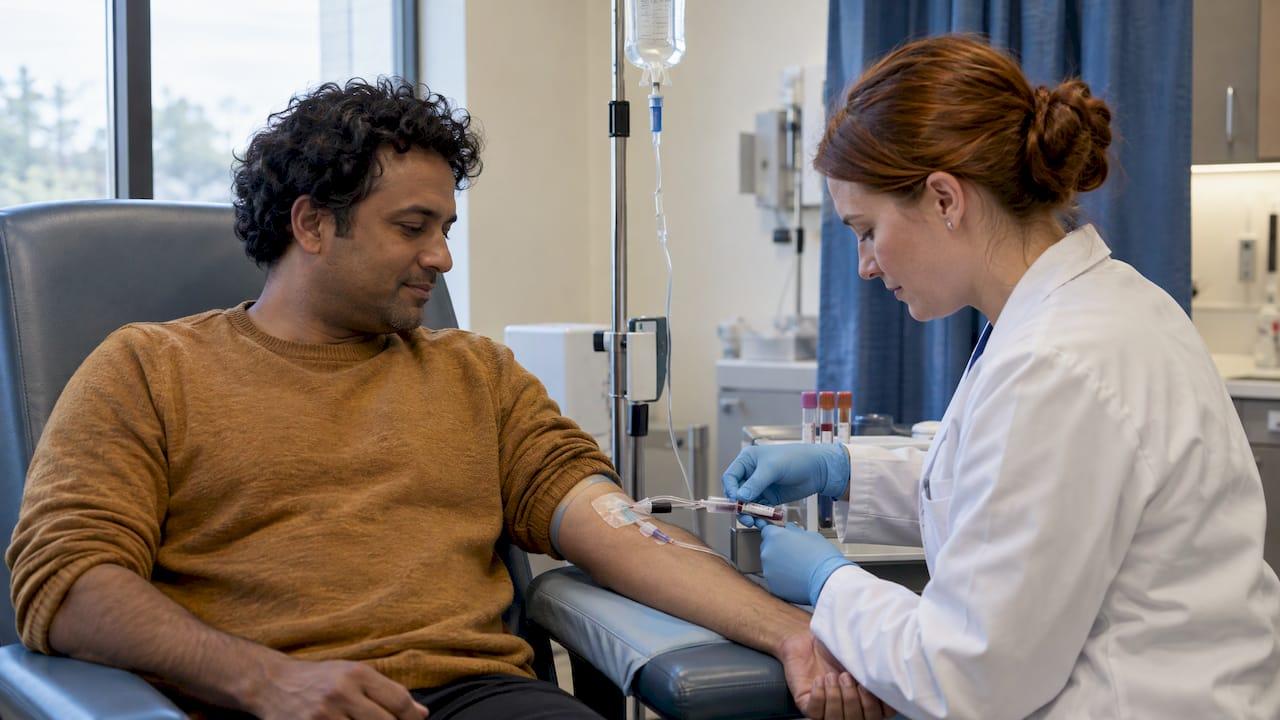
An IV catheter is placed, a medicine is given to cause the pituitary to release GH, and blood samples are collected at regular intervals. MedlinePlus describes several blood draws through an IV line over roughly two hours in its patient overview, and its encyclopedia entry says the whole test typically takes between 2 and 5 hours. After the last sample, the IV is removed and pressure is applied to stop bleeding.
For the macimorelin version, Endotext describes fasting from midnight for 8 to 10 hours, placing an IV cannula, giving one oral dose of 0.5 mg/kg, and drawing blood at 30, 45, 60, and 90 minutes.
Afterward
Most people go home the same day, since the test is done in the outpatient setting. Your clinic will tell you when results are expected and when to eat and resume medicines.
How results are read
Results are not a simple pass or fail on one universal number. The cutoff depends on the test and on your body weight. The ARUP Consult algorithm gives example adult peak GH cutoffs:
| Test | Example peak GH cutoff for deficiency |
|---|---|
| Glucagon stimulation, normal weight or overweight with high pretest probability | 3 ng/mL or below |
| Glucagon stimulation, overweight with low pretest probability, or obese | 1 ng/mL or below |
| Insulin tolerance test | 5.0 ng/mL or below |
| Macimorelin test | 2.8 ng/mL or below |
Those figures come from the ARUP adult testing algorithm. Endotext also states that, when used according to its label, a macimorelin peak GH of 2.8 µg/L or below at any time point is diagnostic of adult GHD.
Two points matter for you as a patient:
- Body weight changes the interpretation, which is why the cutoff differs for people who are obese.
- Your pretest probability, meaning how likely GHD is given your history, shapes how the result is used. An endocrinologist weighs both.
Bring your results to the visit where they are discussed. If you want help reading lab reports in general, our guide to reading lab results safely covers how to approach reference ranges and questions to ask.
If you are diagnosed: what follows
When GH replacement is started, dose is guided by IGF-1. The 2019 AACE/ACE adult GHD guideline says clinicians should use serum IGF-1 as the biomarker for dose adjustments and target a level within the age-adjusted reference range, an IGF-1 SDS between -2 and +2.

The same guideline recommends low starting doses of 0.1 to 0.2 mg/day for patients who also have diabetes, obesity, older age, or previous gestational diabetes, to avoid impairing glucose metabolism. It recommends higher starting doses of 0.3 to 0.4 mg/day for nondiabetic young adults under 30 and for women on oral estrogen. This is why treatment is individualized and monitored by an endocrinologist, with periodic IGF-1 checks.
Our perspective
We see many adults who ask whether low energy or stubborn weight points to a hormone problem. The honest answer is that a growth hormone deficiency evaluation is a specialist workup for a specific medical history, and it deserves the care of an endocrinologist.
What we can say is that good lab work matters in every kind of medical weight care. Our doctor-led approach to personalized GLP-1 care begins with an online intake and clinician evaluation, so your history is reviewed by a licensed clinician before any medication is prescribed. If your history raises questions that call for specialist testing, that is a conversation to have with your clinician.
Our programs bundle clinician oversight, free dietitian visits, and care coaching, so you have support between appointments. For a view of which labs commonly come up in weight care, see our guide to GLP-1 lab tests.
Flexible
Medical weight loss support from Dayla Health
If your goal is weight loss and you want a clinician involved, we offer doctor-led GLP-1 care with transparent cash pricing, no membership fees, and no insurance requirements. Plans are shipped nationwide and include clinician evaluation, medication, care coaching, and dietitian consults.
Current published plans: GLP-1 Injection from $179 per month, GLP-1 Microdose from $159 per month, Oral GLP · Liposomal from $149 per month, and the dayla GLP-1 program at $299 per month. Prescriptions are issued only after a completed intake and clinician approval. See the plans at Dayla Health.
If you take other prescriptions, such as thyroid medication, tell your clinician at intake. Our article on semaglutide drug interactions explains why.
Questions to bring to your endocrinologist
A short list keeps the appointment focused:
- Does my history of pituitary disease, radiation, or head injury justify testing?
- Which stimulation test do you recommend for me, and why?
- Do any of my medicines need to be paused before testing, and for how long?
- How will my body weight affect the cutoff used to read my result?
- If I am diagnosed, how will my dose be chosen and how often will IGF-1 be rechecked?
FAQ
Can a regular blood test diagnose growth hormone deficiency in adults?
Not on its own. GH is released in pulses, so one random sample is unreliable, and the Endocrine Society resource says single GH measurements are not helpful. IGF-1 is a useful first step, but most adults still need a stimulation test to confirm the diagnosis.
Can a normal IGF-1 rule out growth hormone deficiency?
No. The Pituitary Society notes that many people with GHD have normal or low-normal IGF-1. A normal value lowers suspicion in people with a low pretest probability, but an endocrinologist decides whether stimulation testing is still needed.
How long does a growth hormone stimulation test take?
MedlinePlus says the test typically takes between 2 and 5 hours. You fast beforehand, usually 10 to 12 hours, and blood is drawn several times through an IV line. The macimorelin protocol draws blood at 30, 45, 60, and 90 minutes after a single oral dose.
Should I be tested if I am tired and overweight?
Usually not, unless other indications exist. The Pituitary Society advises against routine testing for fatigue or obesity without a history of pituitary disease, head radiation, or severe head trauma. If you are unsure, an endocrinologist can help decide.
Sources
- Growth Hormone Deficiency in Adults and Children, Pituitary Society
- Consensus guidelines for adults with GH deficiency II, GH Research Society
- AACE Patient Guide to Growth Hormone Deficiency
- Growth Hormone Testing in Adult Patients, ARUP Consult
- Adult Growth Hormone Deficiency Diagnosis, Stanford Health Care
- Hormone Replacement in Hypopituitarism, Endocrine Society
- Growth Hormone Tests, MedlinePlus
- Growth hormone stimulation test, MedlinePlus
- Recommended protocol for macimorelin test, Endotext
- AACE/ACE adult GHD guideline, Endocrine Practice, 2019
- Osteopenia vs osteoporosis T-scores
- Growth Hormone Stimulation Testing: To Test or Not to Test, PMC