

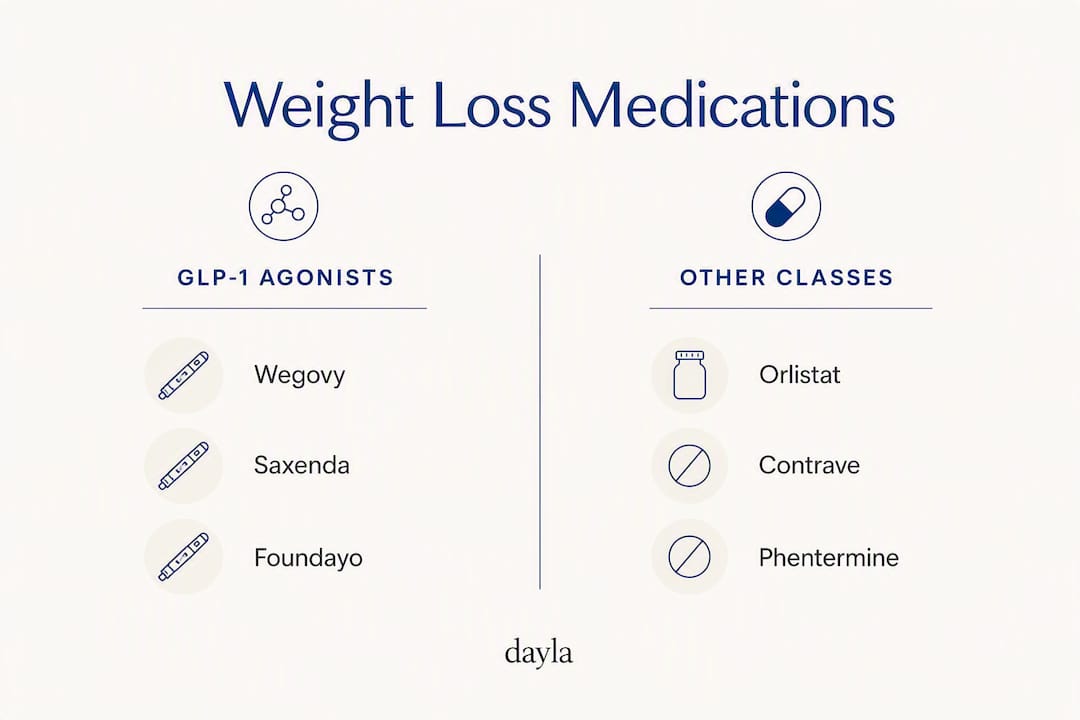
The FDA has approved several prescription medications for chronic weight management in U.S. adults, including semaglutide (Wegovy), tirzepatide (Zepbound), orforglipron (Foundayo), liraglutide (Saxenda), phentermine-topiramate (Qsymia), naltrexone-bupropion (Contrave), and orlistat (Xenical). A separate approval covers setmelanotide (Imcivree) for specific rare genetic obesity disorders. Phentermine alone is approved for short-term use only.
The route matters as much as the drug name. Wegovy, Zepbound, and Saxenda are weekly or daily injectables. Foundayo, Qsymia, Contrave, and Xenical are oral. Phentermine is an oral stimulant approved for short-term use only.
One safety point deserves immediate attention: compounded semaglutide and tirzepatide are not FDA-approved drug products. They do not undergo the same safety, efficacy, or quality review as the branded medications listed above. Before starting any weight loss medication, confirm it is a licensed, FDA-approved product dispensed by a state-licensed pharmacy.
- Injectables (chronic weight management): Wegovy (semaglutide), Zepbound (tirzepatide), Saxenda (liraglutide)
- Oral (chronic weight management): Foundayo (orforglipron), Qsymia (phentermine-topiramate), Contrave (naltrexone-bupropion), Xenical/Alli (orlistat)
- Short-term oral stimulant: Phentermine (Adipex-P, Lomaira)
- Rare genetic obesity only: Imcivree (setmelanotide), approved for ages 6 and older
Table of Contents
- What does the FDA-approved weight loss medications list include?
- How do these medications actually work?
- Who qualifies for a prescription weight loss medication?
- What weight loss results can you realistically expect?
- How long do you stay on these medications?
- How much do these medications cost, and will insurance cover them?
- Why compounded and research peptides are not the same as FDA-approved drugs
- How to get a prescription safely: the evaluation process
- Key Takeaways
- The case for treating weight management as a medical specialty
- Supervised GLP-1 prescriptions, shipped to you
- Useful sources and where we verified approval status
What does the FDA-approved weight loss medications list include?
| Brand (Generic) | Route / Formulation | FDA Indication | Pediatric Approval | Key Prescribing Cautions |
|---|---|---|---|---|
| Wegovy (semaglutide) | Weekly subcutaneous injection | Chronic weight management | Ages 12+ | Personal/family history of medullary thyroid cancer or MEN 2; pancreatitis risk |
| Zepbound (tirzepatide) | Weekly subcutaneous injection | Chronic weight management | Adults only (as of this writing) | Same thyroid/MEN 2 caution as semaglutide; GI tolerability |
| Foundayo (orforglipron) | Daily oral tablet | Chronic weight management | Adults only | Newer agent; GI side effects similar to injectable GLP-1s |
| Saxenda (liraglutide) | Daily subcutaneous injection | Chronic weight management | Ages 12+ | Thyroid tumor risk; pancreatitis; gallbladder disease |
| Qsymia (phentermine-topiramate) | Daily oral capsule | Chronic weight management | Ages 12+ | Contraindicated in pregnancy; glaucoma; hyperthyroidism; teratogenic risk |
| Contrave (naltrexone-bupropion) | Daily oral tablet | Chronic weight management | Adults only | Contraindicated with opioid use; seizure history; uncontrolled hypertension |
| Xenical (orlistat) / Alli (orlistat OTC) | Oral capsule with meals | Chronic weight management | Ages 12+ (Xenical) | Fat-soluble vitamin malabsorption; GI side effects with high-fat meals |
| Adipex-P / Lomaira (phentermine) | Oral tablet/capsule | Short-term (up to 12 weeks) | Adults only | Cardiovascular risk; stimulant; abuse potential |
| Imcivree (setmelanotide) | Daily subcutaneous injection | Rare genetic obesity (POMC, PCSK1, LEPR deficiency; Bardet-Biedl syndrome) | Ages 6+ | Requires genetic confirmation; not for general obesity |
Note: Imcivree is not indicated for common obesity. It targets specific MC4R pathway deficiencies confirmed by genetic testing.
Ozempic (semaglutide 0.5–2 mg) and Mounjaro (tirzepatide 2.5–15 mg) carry FDA approval for type 2 diabetes management, not chronic weight management. FDA approval is indication-specific: a drug approved under one indication and brand is not automatically approved for another, even when the active ingredient is identical.
How do these medications actually work?
These drugs reduce weight through four distinct mechanisms. Understanding the class tells you a lot about what to expect from side effects and dosing schedules.
GLP-1 and GIP/GLP-1 receptor agonists
Wegovy, Zepbound, Saxenda, and Foundayo all work through the glucagon-like peptide-1 (GLP-1) receptor. GLP-1 agonists slow gastric emptying, reduce appetite signals in the hypothalamus, and increase satiety after meals. Tirzepatide (Zepbound) adds a second mechanism: it also activates the glucose-dependent insulinotropic polypeptide (GIP) receptor, which appears to amplify weight loss beyond GLP-1 activation alone.

Foundayo (orforglipron) is the first oral small-molecule GLP-1 receptor agonist approved in this drug class. Unlike semaglutide tablets (Rybelsus, approved for diabetes), orforglipron does not require fasting or water-volume restrictions before dosing, which makes daily adherence more practical. For a deeper look at how GLP-1 medications work, the mechanism and realistic expectations are worth reviewing before starting.
Lipase inhibitor
Orlistat (Xenical, Alli) works entirely in the gut. It blocks pancreatic and gastric lipases, preventing roughly 30% of dietary fat from being absorbed. The mechanism is local, not central, which means no appetite suppression. Side effects are directly tied to fat intake: loose stools, oily spotting, and urgency are common when patients eat high-fat meals. Fat-soluble vitamin supplementation (A, D, E, K) is recommended during treatment.
Combination appetite suppressant and antidepressant
Contrave pairs naltrexone (an opioid antagonist) with bupropion (a dopamine/norepinephrine reuptake inhibitor). Together, they act on the hypothalamus and mesolimbic reward system to reduce food cravings and caloric intake. The naltrexone component is why Contrave is contraindicated in patients currently using opioids or in acute opioid withdrawal.
Qsymia combines phentermine (a norepinephrine-releasing stimulant) with topiramate (an anticonvulsant with appetite-suppressing properties). The combination allows lower doses of each component, reducing the cardiovascular and cognitive side effects seen at higher monotherapy doses.
Stimulant appetite suppressants
Phentermine alone (Adipex-P, Lomaira) releases norepinephrine in the hypothalamus, suppressing appetite. It is approved for short-term use only, up to 12 weeks, because of tolerance development and cardiovascular risk with prolonged use.

MC4R agonist
Setmelanotide (Imcivree) targets the melanocortin-4 receptor (MC4R), a pathway that regulates energy balance. Defects in genes like POMC, PCSK1, or LEPR disrupt this pathway and cause severe early-onset obesity. Imcivree restores MC4R signaling in patients with confirmed genetic mutations. It has no meaningful role in common obesity.
NIDDK confirms that all approved medications are tools, not standalone solutions. Sustained lifestyle changes remain the foundation; medication amplifies the results.
Who qualifies for a prescription weight loss medication?
Standard clinical eligibility follows a clear threshold, though individual factors always apply.
- BMI ≥ 30 kg/m² with no additional comorbidity required.
- BMI ≥ 27 kg/m² with at least one weight-related condition: type 2 diabetes, hypertension, dyslipidemia, obstructive sleep apnea, or cardiovascular disease.
- Prior attempts at lifestyle modification are typically expected before prescribing, though this is not a universal hard requirement.
Clinical guidelines frame obesity pharmacotherapy as adjunctive to diet and physical activity, not a replacement for them. Medication candidacy is also shaped by a patient's comorbidities, current medications, and personal history.
Pediatric approvals are more limited than many people realize. Orlistat (Xenical), Saxenda, Wegovy, and Qsymia are approved for ages 12 and older. Imcivree is approved for ages 6 and older, but only for confirmed genetic disorders. Zepbound, Contrave, phentermine alone, and Foundayo are currently approved for adults only.
Setmelanotide (Imcivree) requires genetic confirmation of a qualifying mutation before prescribing. A clinician will typically order genetic testing through a specialized lab before initiating treatment. This is not a medication a primary care provider prescribes routinely.
For a detailed breakdown of how clinicians assess weight loss medication candidacy, including comorbidity scoring and documentation requirements, that guide covers the evaluation process thoroughly.
What weight loss results can you realistically expect?
Phase 3 randomized controlled trial data gives the clearest picture of what these medications can deliver. The numbers below come from trial summaries and represent mean percent body weight loss in participants who completed the study period.
| Medication | Mean % Weight Loss | Trial Duration | Notes |
|---|---|---|---|
| Tirzepatide (Zepbound) | ~20.9% | 72 weeks | Highest mean weight loss in Phase 3 trials |
| Semaglutide (Wegovy) | ~14.9% | ~68 weeks | High mean weight loss in Phase 3 trials |
| Orforglipron (Foundayo) | ~11.1% | 72 weeks | Notable mean weight loss in Phase 3 trials |
| Liraglutide (Saxenda) | ~8% | 56 weeks | Moderate mean weight loss in Phase 3 trials |
| Phentermine-topiramate (Qsymia) | 6–9% | 56 weeks | Dose-dependent mean weight loss |
| Naltrexone-bupropion (Contrave) | 5–6% | 56 weeks | Modest mean weight loss |
| Orlistat (Xenical) | 3–5% | 52 weeks | Modest mean weight loss, dependent on dietary fat intake |
These are mean figures from controlled trial populations. Individual results vary based on adherence, baseline weight, diet quality, and comorbidities.
Common side effects by drug class
GLP-1/GIP agonists (Wegovy, Zepbound, Saxenda, Foundayo): Nausea, vomiting, diarrhea, and constipation are the most frequent complaints, particularly during dose escalation. Most patients see GI symptoms improve after the first few weeks at a stable dose.
Naltrexone-bupropion (Contrave): Nausea, headache, insomnia, and dry mouth are common. Neuropsychiatric effects, including mood changes, carry a boxed warning. Blood pressure monitoring is recommended at initiation.
Orlistat (Xenical/Alli): Oily stools, fecal urgency, and flatulence are directly proportional to dietary fat intake. Rare cases of severe liver injury have been reported.
Phentermine and phentermine-topiramate: Elevated heart rate, insomnia, dry mouth, and constipation. Topiramate adds cognitive dulling ("brain fog") and word-finding difficulty at higher doses.
Serious risks and contraindications
- GLP-1/GIP agonists: personal or family history of medullary thyroid carcinoma or multiple endocrine neoplasia type 2 (MEN 2) is an absolute contraindication. Pancreatitis and gallbladder disease are rare but documented risks.
- Qsymia: teratogenic. Pregnancy testing is required before initiation and monthly during treatment. Contraindicated with glaucoma and hyperthyroidism.
- Contrave: contraindicated with current opioid use, opioid withdrawal, seizure disorders, and uncontrolled hypertension. The bupropion component carries a boxed warning for suicidal ideation in certain populations.
- Phentermine: cardiovascular risk, including elevated blood pressure and heart rate. Not appropriate for patients with a history of heart disease or uncontrolled hypertension.
Pro Tip: Clinicians commonly use a 12-week efficacy check: if you have not lost approximately 5% of your starting body weight by week 12, the prescribing guidelines suggest the medication is unlikely to produce meaningful long-term benefit, and your clinician may recommend discontinuing or switching.
How long do you stay on these medications?
Most FDA-approved chronic weight management medications are designed for long-term use, not a fixed course. Obesity is classified as a chronic condition, and the approved labeling for agents like Wegovy, Zepbound, and Saxenda reflects that framing. Patients who tolerate the medication and continue to benefit are generally expected to remain on it indefinitely, similar to how someone with hypertension stays on antihypertensives.
The 12-week reassessment benchmark described above is a practical checkpoint, not a stopping rule. If you clear that threshold, the clinical expectation is continued use with periodic monitoring.
What happens when people stop? The evidence is consistent: weight regain is common after discontinuation, particularly with GLP-1 and GIP agonists. The appetite-suppressing and satiety effects are pharmacological. When the drug is removed, those effects reverse. Lifestyle habits built during treatment can slow regain, but they rarely prevent it entirely without ongoing medical support.
- If stopping is planned, taper the dose under clinician guidance rather than stopping abruptly.
- Schedule a follow-up within four to six weeks of discontinuation to monitor weight trajectory.
- Reinforce dietary and physical activity habits before stopping, not after.
- Discuss whether a lower maintenance dose is an option before full discontinuation.
The chronic-use framing also has insurance implications. Plans that cover short-term prescriptions may not cover ongoing refills without periodic prior authorization renewals.
How much do these medications cost, and will insurance cover them?
Cost is one of the most practical barriers to access. GLP-1 and GIP/GLP-1 injectable medications carry high list prices without insurance, often exceeding $1,000 per month at retail. Oral options like Contrave and Qsymia tend to be less expensive, and generic orlistat is available at significantly lower cost.
Insurance coverage is inconsistent and plan-specific:
- Many commercial plans cover GLP-1 medications for type 2 diabetes but exclude the weight management indication. Wegovy and Zepbound, approved specifically for obesity, face more coverage denials than Ozempic or Mounjaro.
- Medicare Part D currently has limited coverage for weight loss medications, though this is an evolving policy area.
- Medicaid coverage varies by state.
Practical steps to reduce out-of-pocket costs:
- Ask your clinician or pharmacist about manufacturer savings cards. Novo Nordisk (Wegovy) and Eli Lilly (Zepbound) offer patient assistance programs with eligibility requirements.
- Prior authorization is almost always required for GLP-1 agents. Your clinician's office typically handles this, but you may need to provide documentation of BMI, comorbidities, and prior treatment attempts.
- Step therapy requirements mean some insurers require a trial of an older, less expensive agent before approving a newer GLP-1.
- Compare the cash price at multiple pharmacies. GoodRx and similar tools show significant variation between pharmacy chains.
- If you are uninsured or underinsured, ask about manufacturer patient assistance programs directly, as income-based eligibility can substantially reduce monthly costs.
Why compounded and research peptides are not the same as FDA-approved drugs
This distinction is worth understanding clearly before making any purchasing decision.
Compounded versions of semaglutide and tirzepatide are not FDA-approved drug products. Compounding pharmacies are permitted to produce copies of branded medications under specific regulatory conditions, such as documented drug shortages, but these products do not undergo the FDA's pre-market review for safety, efficacy, or manufacturing quality. The FDA has issued warnings about compounded semaglutide and tirzepatide products, including concerns about incorrect dosing and contamination.
Research peptides are a separate and more concerning category. Compounds like AOD-9604, BPC-157, and MOTS-c are sometimes marketed for weight loss or metabolic benefits. None of these have completed Phase 2 or Phase 3 randomized controlled trials in humans for weight management. The FDA has taken regulatory action against some distributors selling these compounds for human use. Calling something a "peptide" does not make it equivalent to an FDA-approved peptide-based drug like semaglutide or liraglutide.
The practical risk is real: dosing errors, unknown impurities, and lack of clinical oversight create genuine safety exposure. For a clear breakdown of peptide therapy misconceptions that circulate online, that resource addresses the most common marketing claims directly.
Pro Tip: Before filling any weight loss prescription, verify the dispensing pharmacy holds an active state pharmacy license and ask for a certificate of analysis (COA) confirming lot-level testing. Legitimate compounding pharmacies provide this documentation without hesitation.
Many marketed "peptide therapies" blend FDA-approved drugs, compounded versions, and research peptides in ways that obscure which category you are actually receiving. Clinicians who specialize in obesity medicine treat these categories as fundamentally different, not interchangeable.
How to get a prescription safely: the evaluation process
Getting a prescription for a weight management medication involves more than a BMI check. A thorough clinical evaluation protects you and helps your clinician choose the right medication.
- Complete a medical history review. Your clinician will ask about cardiovascular history, thyroid conditions, mental health history, seizure disorders, pregnancy status, and current medications. This rules out contraindications before any prescription is written.
- Confirm BMI and comorbidities. Your weight, height, and any qualifying conditions (hypertension, type 2 diabetes, sleep apnea) are documented to establish eligibility and support insurance prior authorization if needed.
- Baseline labs. Depending on the medication being considered, expect a metabolic panel, HbA1c, lipid panel, and renal and hepatic function tests. These establish a baseline and screen for conditions that affect drug choice.
- Pregnancy testing. Required before starting Qsymia and recommended before initiating other agents in people of childbearing potential.
- Medication review. Your full medication list is checked for interactions. Contrave, for example, cannot be used with opioids or MAOIs. Topiramate (in Qsymia) interacts with several anticonvulsants and hormonal contraceptives.
- Dose titration plan. GLP-1 agents require gradual dose escalation over weeks to months to minimize GI side effects. Your clinician should outline the titration schedule before you start.
- Monitoring schedule. Expect follow-up at 4 weeks, 12 weeks, and then quarterly. Blood pressure, weight, labs, and side effect assessment are standard checkpoints.
Questions worth asking your clinician before starting:
- Which contraindications apply to me specifically?
- What is the realistic weight loss range for this medication at my starting weight?
- What is the plan if I do not reach the 5% threshold at 12 weeks?
- How will we handle insurance prior authorization?
- Are manufacturer assistance programs available for this drug?
Medically supervised weight loss consistently produces better outcomes than self-directed approaches, largely because dose titration, side effect management, and lifestyle coaching happen in parallel.
Key Takeaways
The FDA has approved seven medications for chronic weight management in U.S. adults, with tirzepatide (~20.9% mean weight loss at 72 weeks) and semaglutide (~14.9% mean weight loss at ~68 weeks) delivering the largest reductions in Phase 3 trials, and all require clinical oversight and lifestyle modification to be effective.
| Point | Details |
|---|---|
| FDA-approved options | Seven drugs cover chronic weight management; phentermine is short-term only; Imcivree is for rare genetic obesity. |
| Efficacy range | Trial data shows mean weight loss from ~3–5% (orlistat) to ~20.9% (tirzepatide), depending on the agent. |
| Compounded products | Compounded semaglutide and tirzepatide are not FDA-approved; they lack pre-market safety and quality review. |
| Eligibility threshold | BMI ≥ 30, or ≥ 27 with a qualifying comorbidity, is the standard clinical entry point for most approved medications. |
| Daylahealth | Daylahealth provides clinician-led GLP-1 prescriptions with care coaching and nationwide shipping, no insurance required. |
The case for treating weight management as a medical specialty
The most underappreciated shift in obesity medicine over the past decade is not the arrival of GLP-1 drugs. It is the reclassification of obesity as a chronic disease requiring ongoing medical management, not a willpower problem requiring a diet. That framing change is what makes the FDA-approved medication list meaningful rather than just a list of drugs.
What most articles miss is the implication: if obesity is chronic, then stopping medication when you "reach your goal" is roughly equivalent to stopping blood pressure medication when your numbers normalize. The biology does not change because the scale does. The weight regain data after GLP-1 discontinuation is not a failure of the drug. It is evidence that the underlying condition persists.
The practical consequence for anyone evaluating these medications is this: the question is not just "which drug works best?" It is "which drug can I tolerate, afford, and stay on long enough for the clinical benefit to compound?" Tirzepatide's ~20.9% mean weight loss in trials is impressive. But a medication that produces ~14.9% weight loss (as seen with semaglutide) and that you can actually sustain for three years outperforms one that delivers 20.9% for six months before cost or side effects force a stop.
Clinician selection matters enormously here. A prescriber who understands dose titration, monitors for side effects proactively, and adjusts the plan when the 12-week benchmark is not met is not a luxury. It is the difference between a medication that works and one that gets abandoned.
Supervised GLP-1 prescriptions, shipped to you
Daylahealth offers a direct path to clinician-reviewed GLP-1 prescriptions without the insurance maze. The model is straightforward: complete an online intake, receive a clinician evaluation, and get your medication shipped nationwide with ongoing care coaching and dietitian access included.
Every prescription goes through a licensed clinician review. Daylahealth does not dispense research peptides as weight loss treatments, and all compounded products are sourced from state-licensed pharmacies with documented lot testing. If your evaluation indicates that in-person specialty care is the right fit, your care team will tell you directly.
For adults who qualify and want medically supervised access to FDA-approved GLP-1 therapy without requiring insurance, start your GLP-1 evaluation at Daylahealth and get a clinician decision within 24 hours.
Useful sources and where we verified approval status
The FDA approval statuses, indications, and pediatric age thresholds in this article were verified against primary regulatory and clinical sources. Approval status can change; check DailyMed and the FDA drug database for the most current labeling.
Last checked: 2026.
- Prescription Medications to Treat Overweight & Obesity — NIDDK: Primary NIH reference for approved drug list, pediatric approvals, and indication summaries.
- Contrave (naltrexone-bupropion) prescribing information — DailyMed: Official label for Contrave, including indication, contraindications, and monitoring guidance.
- Current Pharmacologic Treatment of Overweight and Obesity in Adults — EndoText: Clinical reference for eligibility criteria, orlistat mechanism, and chronic-use framing.
- Prescription weight-loss drugs — Mayo Clinic: Practical overview of compounded product risks and FDA regulatory distinctions.
- FDA Drug Approvals and Databases — FDA.gov: Primary source for verifying current approval status and labeling for all listed medications.
- FDA-Approved Obesity Medications Table — StatPearls / NCBI Bookshelf: Peer-reviewed summary table of approved agents, mechanisms, and indications.
- Types of Weight Loss Prescriptions Available — Daylahealth Blog: Daylahealth's overview of prescription categories and newer agents for deeper reading.
- How Peptides Help Weight Loss: What the Evidence Shows — Daylahealth Blog: Evidence review and clinical limits of peptide therapies, including research peptide distinctions.