

A Registered Dietitian (RD or RDN) is a credentialed nutrition professional who has completed accredited education, supervised clinical training, and a national registration exam. "Nutritionist" is an unregulated title in many states, so training behind it varies widely. For medical conditions, diabetes, kidney disease, disordered eating, choose an RD/RDN and verify their credential before your first appointment.
TL;DR:
- Verify the practitioner's registration status through the CDR registry to ensure they are an accredited dietitian or RDN before booking an appointment.
- Check whether they have licensed state credentials, especially if you are seeking medically supervised nutrition care or insurance reimbursement.
- Confirm they have supervised clinical hours and experience managing your specific medical condition for reliable, evidence-based guidance.
- Be cautious of unqualified nutritionists with unverified training or those offering guaranteed results or selling supplements prematurely.
- For medical conditions or weight-loss programs involving medications, choose a credentialed dietitian to safely monitor drug-nutrition interactions and provide individualized care.
Table of Contents
- Dietitian vs Nutritionist: Key Differences at a Glance
- Education and Credential Requirements: RD/RDN vs. Nutritionist
- What RDs Can Do That Most Nutritionists Can't
- How State Licensing Rules Change What You're Actually Getting
- How to Choose: Verification Checklist and Questions to Ask
- When to See a Dietitian vs. a Nutritionist
- Why Credentialed Dietitians Matter in Medically Supervised Weight-Loss Care
- What Matters Most When Choosing Between the Two
- Sources
Dietitian vs Nutritionist: Key Differences at a Glance
The credential gap comes down to standardization. An RD or RDN has followed one accredited path with defined checkpoints. A nutritionist may have followed almost anything, from a graduate degree to a weekend course.
- RD/RDN: Accredited degree, supervised practice, national exam through the Commission on Dietetic Registration (CDR), ongoing continuing education.
- CNS (Certified Nutrition Specialist): Requires a graduate degree and supervised hours, but it's a separate credentialing body from CDR.
- "Nutritionist" (unqualified title): No standardized education requirement in most states, meaning training can range from extensive to minimal.
- Clinical authority: RDs/RDNs provide Medical Nutrition Therapy (MNT) and work inside hospital and clinical teams; nutritionists more often focus on general wellness coaching.
- Insurance: RDN services are more likely to qualify for insurance reimbursement since payers recognize the credential.
Everything below unpacks why that gap exists and what it means for the care you actually receive.
Education and Credential Requirements: RD/RDN vs. Nutritionist
The RD/RDN pathway runs through the Accreditation Council for Education in Nutrition and Dietetics (ACEND). Candidates complete an ACEND-accredited degree program, and as of 2024, new candidates entering the pathway are expected to hold a graduate degree rather than a bachelor's alone. That change raised the bar for anyone starting the process today.
After coursework, candidates complete supervised practice, typically delivered through a dietetic internship or a coordinated program that combines classroom and clinical hours.
Registered dietitians typically complete a substantial number of hours of supervised practical training before they're eligible to sit for the national registration exam administered by the CDR. Passing that exam earns the RD or RDN credential, and maintaining it requires ongoing continuing education, not a one-time certificate.
"Nutritionist" doesn't run through any single pipeline like this. Some paths worth knowing:
- Certified Nutrition Specialist (CNS): Requires a graduate degree and supervised practice hours, administered by a different certifying board than CDR.
- Private certificate programs: Range from legitimate continuing-education courses to short online programs with no supervised practice or exam requirement at all.
- Self-taught or uncertified "nutritionist": In states without title protection, anyone can use the term regardless of formal training.
A certificate on a wall doesn't tell you which of these paths someone took. That's why the credential letters after a name, RD, RDN, or CNS, carry more verifiable weight than the job title alone.
What RDs Can Do That Most Nutritionists Can't
Medical Nutrition Therapy is the dividing line in clinical authority. MNT is an evidence-based process for using nutrition to manage a diagnosed condition, and RDs and RDNs are the credentialed practitioners authorized to provide it. Examples include:
- Adjusting carbohydrate intake and meal timing for someone managing diabetes.
- Designing renal-appropriate diets that control potassium, phosphorus, and protein for kidney disease patients.
- Managing enteral or parenteral nutrition for patients who can't eat normally after surgery or during critical illness.
RDs typically work inside hospitals and outpatient clinics as part of a physician-led team, which means they're positioned to monitor lab values and flag medication interactions before those interactions cause harm. A nutritionist working outside that structure often lacks the training to catch those risks.
Neither credential allows diagnosis or prescribing. RDs and nutritionists alike refer patients back to physicians for those decisions. But uncredentialed advice for someone managing multiple conditions or medications carries real risk, since nonstandard training can miss drug-nutrition interactions that a clinically trained RD would catch immediately.
Pro Tip: If you're on any prescription medication, ask directly whether the practitioner has experience with drug-nutrient interactions specific to your condition. A vague answer is itself useful information.
How State Licensing Rules Change What You're Actually Getting
Licensure isn't uniform across the country, and that inconsistency is exactly why credential-checking matters more than assuming a title means what it sounds like. Some states legally require licensure to practice as a dietitian or to use the title. Many states don't regulate "nutritionist" at all, so the same title can mean very different things depending on your zip code.
- Some states license dietitians and restrict who can perform MNT or use protected titles.
- Many states leave "nutritionist" completely unregulated, allowing broad use regardless of training.
- Look up your state's specific rules through your state licensing board or Bureau of Labor Statistics occupational guidance before assuming a title guarantees a scope of practice.
- Insurance reimbursement tends to follow recognized credentials, so an RDN's services are more often billable than a nutritionist's, which is a practical clue about legitimacy even before you check licensure.
If you're paying out of pocket either way, this might feel academic. If you're hoping insurance covers the visit, it isn't.
How to Choose: Verification Checklist and Questions to Ask
Before booking, run through a short verification process rather than trusting a website bio or social media following.
- Check CDR registry status. Confirm RDN standing directly through the Commission on Dietetic Registration database rather than taking a practitioner's word for it.
- Verify state licensure if applicable. Some states require it; your state board's website will confirm.
- Ask about supervised clinical hours and condition-specific experience. A dietitian who has managed diabetes cases for years brings more than one who hasn't.
- Ask whether they provide MNT and bill insurance. Insurance billing is a fast, practical signal of recognized credentials.
Watch for red flags too: promises of dramatic or guaranteed results, rigid one-size-fits-all meal plans handed out before any real assessment, or pressure to purchase specific supplements the practitioner happens to sell.
Pro Tip: Ask any practitioner one direct question before booking: "Are you a Registered Dietitian, and can I verify that through CDR?" A confident, specific answer tells you more than any credential displayed on a website.
When to See a Dietitian vs. a Nutritionist
Match the professional to the stakes involved, not just to convenience or cost.
- See an RD/RDN for: Diabetes management, chronic kidney disease, eating disorder recovery, recovery nutrition after major surgery, or any condition where a physician or insurer has referred you specifically for Medical Nutrition Therapy.
- A nutrition professional may be appropriate for: General wellness goals, basic meal planning, or sports nutrition guidance where no diagnosed medical condition is involved.
- Insurance and referral situations: Many physicians and insurers require the RD/RDN credential specifically for reimbursed nutrition counseling, so check before you book if cost matters.
The lower the medical stakes, the more flexibility you have. The higher the stakes, the more the credential gap actually shows up in your outcomes.
Why Credentialed Dietitians Matter in Medically Supervised Weight-Loss Care
Weight-loss medication changes how your body processes food, appetite signals, and nutrients, which is exactly the kind of shift where a credentialed dietitian's training earns its keep. Programs that pair a prescriber with a registered dietitian are built to catch drug-nutrition interactions and adjust meal planning as your body responds to treatment, something general wellness coaching isn't structured to do.
Daylahealth's GLP-1 program is built around that pairing: clinician oversight alongside dietitian consults, not medication shipped without follow-up. If you're evaluating any medically supervised weight-loss program, ask these questions first:
- Is there ongoing clinician oversight, not just an initial prescription?
- Do I have access to a registered dietitian, and how often?
- What's the monitoring schedule for dosage adjustments and side effects?
- What's the protocol if I have an adverse reaction?
Nutrition guidance during GLP-1 treatment works best when it's individualized, not generic, particularly as appetite and food tolerance shift week to week.
What Matters Most When Choosing Between the Two
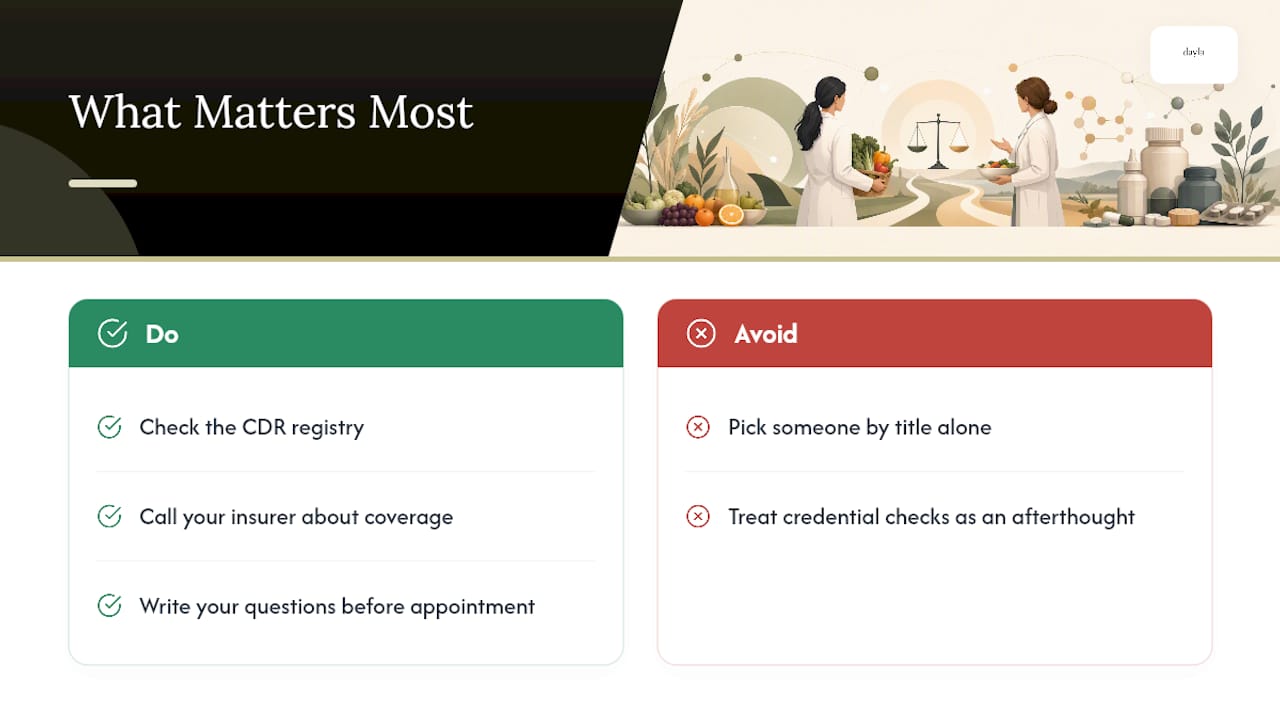
The conventional advice, "just pick whichever sounds more qualified," misses the actual decision point. The real question isn't which title sounds more official. It's whether the person advising you has been trained to catch what happens when nutrition intersects with a diagnosed condition or a prescription medication. That training is standardized for RDs and RDNs and inconsistent for nutritionists, not because nutritionists lack knowledge, but because the title itself guarantees nothing.
My practical advice: treat credential verification as a five-minute task, not an afterthought. Check the CDR registry, call your insurer about coverage, and write down your questions before the appointment starts.
— Flexible
This article is general information, not a substitute for advice from a qualified doctor. Consult a qualified healthcare professional about your own circumstances before acting on anything here.
Sources
- Dietitians and Nutritionists: Occupational Outlook Handbook
- Dietitians vs. Nutritionists: What’s the Difference?
- Dietitian vs Nutritionist: What is the Difference?