
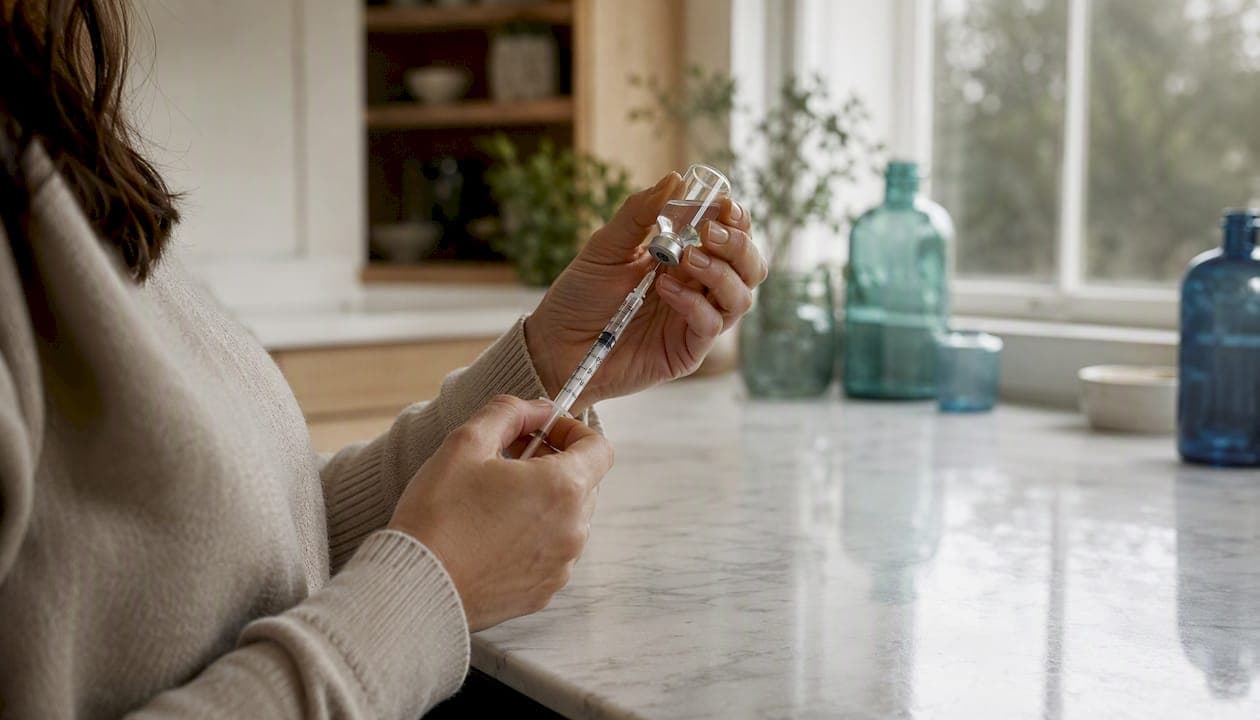
A clinician-supervised starting protocol for most adults is a typical starting dose of 100 mcg CJC-1295 (no-DAC) combined with 100–200 mcg ipamorelin, injected subcutaneously before bed, run for 8–12 weeks on with a 4-week break. That single combination covers the majority of goals: improved sleep quality, faster recovery, modest lean mass gains, and gradual fat loss. Medical screening and baseline labs are required before you begin. Daylahealth provides clinician-supervised prescribing, lab review, and nationwide shipping for patients who qualify.
Quick reference:
- Starting dose: 100 mcg CJC-1295 no-DAC + 100–200 mcg ipamorelin per injection
- Frequency: once daily, pre-bed (fasted, 2+ hours after the last meal)
- Cycle: a cycle period followed by a break period.
- Unit conversion: on a standard insulin syringe, a conversion of insulin syringe units to micrograms (using a 20 mg blended vial reconstituted with 3.0 mL of bacteriostatic water)
- Typical daily total: 100–300 mcg per peptide, depending on the clinician-adjusted protocol
- Baseline labs required: IGF-1, fasting glucose, HbA1c, CMP, thyroid panel
Table of Contents
- What are CJC-1295 and Ipamorelin, and why are they combined?
- What side effects and safety risks should you know before starting?
- How do you dose and cycle CJC-1295 + Ipamorelin correctly?
- When should you inject for the best GH response?
- How do you reconstitute and inject CJC-1295 + Ipamorelin safely?
- How should you store reconstituted peptide vials?
- What labs do you need before and during a cycle?
- How long before you see results, and how do you track progress?
- How does Daylahealth approach clinician-supervised peptide therapy?
- Key Takeaways
- The case for supervised protocols over DIY sourcing
- Clinician-supervised peptide therapy through Daylahealth
- Useful sources
What are CJC-1295 and Ipamorelin, and why are they combined?
CJC-1295 is a synthetic analog of growth hormone-releasing hormone (GHRH). It binds GHRH receptors in the pituitary and signals the gland to release growth hormone (GH). Ipamorelin is a selective ghrelin receptor agonist (GHS-R1a) that triggers GH release through a completely separate receptor pathway. When you use both together, the two signals arrive at the pituitary simultaneously and produce a GH pulse that is substantially larger than either compound generates alone.
Each agent, in one line:
- CJC-1295 (with DAC): same GHRH analog with a Drug Affinity Complex that extends half-life to roughly 5–8 days; produces a sustained GH elevation rather than a discrete pulse
- Ipamorelin: selective GHS-R1a agonist that releases GH with minimal cortisol or prolactin elevation, making it the cleanest GHRP available
The no-DAC form is the standard clinical choice for stacking because it preserves the natural pulsatile pattern of GH secretion. DAC's multi-day half-life creates a continuous GH bleed rather than a pulse, which most clinicians consider less physiologic and harder to titrate. Think of it this way: no-DAC mimics the body's own rhythm; DAC trades that rhythm for convenience.
What side effects and safety risks should you know before starting?
Most side effects from this stack are mild and dose-dependent. The more serious concerns are rare but require screening before you begin.
Common side effects:
- Water retention and mild joint discomfort, especially in the first 2–4 weeks
- Tingling or numbness in the hands (transient, usually resolves with dose adjustment)
- Injection-site redness, bruising, or mild swelling
- Transient fatigue or headache shortly after injection
- Mild increase in hunger (more common with higher ipamorelin doses)
Serious concerns and red flags:
- Suspected or confirmed active malignancy: GH-axis stimulation is contraindicated
- Uncontrolled diabetes or significant insulin resistance: glucose dysregulation risk
- Pregnancy or breastfeeding: no safety data; contraindicated
- Signs of acromegaly (joint enlargement, coarsening facial features, carpal tunnel): stop immediately and consult your clinician
- Unexplained edema that does not resolve within 2 weeks of dose reduction
Clinicians at major medical centers recommend individualized screening before initiating any therapy that alters GH axis physiology. Mayo Clinic guidance on growth hormone therapies specifically highlights the need to rule out malignancy and metabolic contraindications before prescribing. Self-sourcing peptides without that screening removes the safety net that makes this therapy appropriate.
Drug interactions to screen for: insulin and antidiabetic medications (additive glucose effects), corticosteroids (blunt GH response), and thyroid hormone replacement (may require dose adjustment as GH affects T4-to-T3 conversion).
Stop or adjust if: IGF-1 rises above the upper limit of the age-adjusted reference range, fasting glucose climbs above 100 mg/dL from a normal baseline, or edema or joint pain becomes functionally limiting.
How do you dose and cycle CJC-1295 + Ipamorelin correctly?
Standard clinical practice uses a clinician-adjusted per-injection peptide dosage, with most clinicians starting at the lower end and titrating based on IGF-1 response and tolerability. The table below maps the key variables for both variants:
| Variant | Typical dose per injection | Frequency | Cycle (on/off) | Primary outcome |
|---|---|---|---|---|
| CJC-1295 no-DAC + Ipamorelin | 100 mcg CJC-1295 no-DAC + 100–200 mcg ipamorelin | once daily pre-bed (default), up to 2–3× daily in extended protocols | a cycle period followed by a break period | Pulsatile GH; sleep, recovery, body composition |
| CJC-1295 with DAC | 100–300 mcg | 1–2× per week | cycles commonly have a period on and a scheduled break | Sustained GH elevation; convenience-focused |
| Extended no-DAC protocol | 200–300 mcg each | 2× daily | extended cycles with longer dosing durations and breaks | Deeper body-composition change; requires closer monitoring |
Vial math and unit conversion
A common compounding format is a 20 mg pre-blended vial (10 mg CJC-1295 + 10 mg ipamorelin). Reconstituted with 3.0 mL of bacteriostatic water, which gives a concentration of approximately 6.67 mg/mL total (3.33 mg/mL per peptide). On a standard 100-unit insulin syringe:
- a conversion of insulin syringe units to micrograms of each peptide
- 20 units = 200 mcg of each peptide
- 30 units = 300 mcg of each peptide
Month-by-month protocol (standard 12-week cycle)
Weeks 1–2 (initiation): Start at 100 mcg CJC-1295 no-DAC + 100 mcg ipamorelin once daily, pre-bed. This lower dose lets you assess tolerability and watch for water retention or glucose changes before committing to a full dose.
Weeks 3–6 (escalation): If week 1–2 labs and symptoms are stable, increase ipamorelin to 200 mcg per injection. Some clinicians also increase CJC-1295 to 200 mcg at this stage, particularly for patients prioritizing body composition over sleep quality alone.
Weeks 7–12 (maintenance): Hold at the escalated dose. Most clinicians keep the ceiling at 200 mcg CJC-1295 + 200 mcg ipamorelin once daily for first-cycle patients. A second daily injection (morning, fasted) may be added for patients with specific performance goals, under clinician review.
Off period (weeks 13–16): Four weeks off allows the pituitary to reset its natural GHRH sensitivity. Skipping the break reduces the protocol's long-term effectiveness.
Pro Tip: Pre-bed injection is not just a timing preference. The body's largest natural GH pulse occurs during early slow-wave sleep, and injecting 30–60 minutes before sleep amplifies that pulse directly. Eating within 2 hours of injection blunts the response because elevated insulin suppresses GH release. Treat the pre-bed window as non-negotiable.
When should you inject for the best GH response?
Growth hormone secretion is concentrated during early slow-wave sleep, making the pre-bed window the single highest-yield injection timing for most patients. Elevated insulin from a recent meal suppresses GH release at the pituitary level, so the fasted state before bed is physiologically ideal.
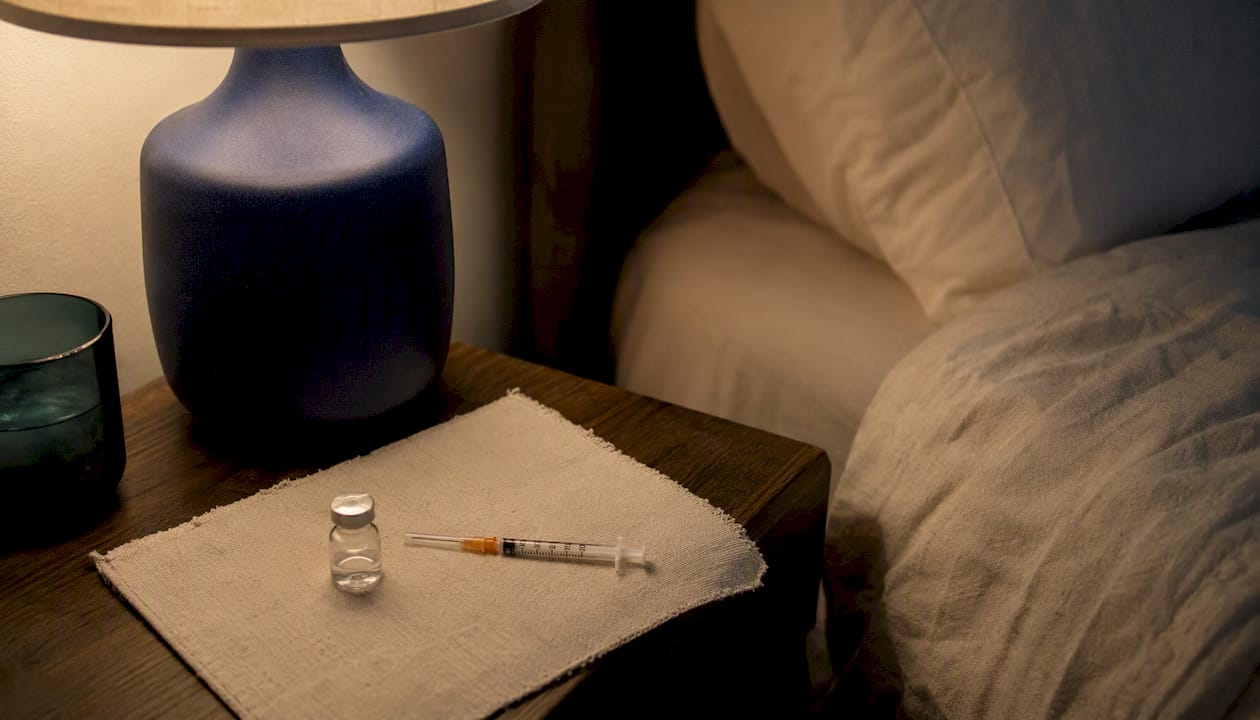
Once-daily (pre-bed): The default for first-cycle patients and anyone prioritizing sleep and recovery. Inject 30–60 minutes before sleep, at least 2 hours after your last meal. This is the protocol with the strongest clinical rationale and the easiest adherence.
Twice-daily (AM + pre-bed): Adding a morning injection in a fasted state captures a secondary GH window and is appropriate for patients with body-composition goals who have already tolerated the once-daily protocol for at least 4 weeks. The morning dose should be taken immediately upon waking, before breakfast or coffee with cream. Expect a modest increase in hunger.
Three-times-daily: Used in some extended protocols for experienced patients with specific performance targets. The third injection is typically placed mid-afternoon, at least 2 hours after lunch and 2 hours before dinner. This schedule requires precise meal timing and is best managed under active clinician oversight.
Rotating injection sites matters more than most patients expect. Subcutaneous fat at a single site can develop lipohypertrophy with repeated injections, which reduces absorption consistency. Rotate among the abdomen (2 inches from the navel), outer thigh, and upper outer arm. Keep a simple rotation log.
Pro Tip: If you train in the morning, the pre-bed injection still outperforms a post-workout injection for GH amplitude. Post-workout GH is already elevated naturally; the peptide stack adds more value when GH is at its baseline, which is the pre-sleep window.
How do you reconstitute and inject CJC-1295 + Ipamorelin safely?
Sterile technique is not optional. A contaminated vial can cause a serious infection. Follow these steps exactly.
Reconstitution (step-by-step)
- Wash hands thoroughly with soap and water for at least 20 seconds.
- Wipe the rubber stopper of the peptide vial and the bacteriostatic water (BAC water) vial with a fresh alcohol swab. Allow both to air-dry for 10 seconds.
- Draw the required volume of BAC water into a sterile syringe (3.0 mL for a 20 mg blended vial).
- Insert the needle into the peptide vial at an angle and inject the BAC water slowly down the inside wall of the vial. Do not aim the stream directly at the powder.
- Gently swirl the vial until the powder is fully dissolved. Never shake it. Shaking denatures the peptide.
- The solution should be clear and colorless. Any cloudiness, particulate matter, or discoloration means the vial is compromised. Discard it.
- Label the vial with the date of reconstitution. Store immediately in the refrigerator at 2–8°C.
Drawing and injecting (numbered checklist)
- Remove the vial from the refrigerator and allow it to reach room temperature for 5–10 minutes.
- Wipe the rubber stopper with a fresh alcohol swab and allow it to air-dry.
- Draw the calculated dose into a 29- or 31-gauge insulin syringe (e.g., 20 units for 200 mcg of each peptide in a 3.0 mL reconstituted 20 mg blend).
- Check for air bubbles. Tap the syringe and push them out gently.
- Select your injection site. Clean with an alcohol swab and allow to dry.
- Pinch a small fold of skin between your thumb and forefinger.
- Insert the needle at a 45-degree angle for leaner individuals or 90 degrees if there is adequate subcutaneous fat.
- Inject slowly and steadily. Do not aspirate.
- Withdraw the needle and apply gentle pressure with a clean swab. Do not rub.
- Dispose of the used syringe immediately in a sharps container. Never recap and reuse needles.
Sterility warning: If the solution appears cloudy, has visible particles, or smells unusual at any point, discard the entire vial. Peptide contamination is not always visible, which is why sourcing from a licensed compounding pharmacy matters.
How should you store reconstituted peptide vials?
Proper storage directly affects both potency and safety. Reconstituted peptides are far more sensitive to temperature and light than the sealed lyophilized powder.
Storage rules:
- Sealed, lyophilized (powder) vials: refrigerate at 2–8°C; keep away from direct light
- Reconstituted vials: refrigerate at 2–8°C immediately after mixing; do not freeze
- Shelf life after reconstitution: about a month when stored properly under refrigeration, consistent with standard compounding practice
- Room temperature: brief exposure (under 30 minutes) during injection prep is acceptable; do not leave vials at room temperature for extended periods
Discard the vial immediately if you notice:
- Cloudiness or haziness in the solution
- Visible particles or floating matter
- Discoloration (any color other than clear)
- Unusual or off odor when the stopper is punctured
- Any crack or damage to the vial
Travel and handling checklist:
- Transport reconstituted vials in an insulated cooler with ice packs; keep temperature below 8°C
- Carry documentation from your prescribing clinician if traveling by air
- Never check peptide vials in luggage where temperature control is uncertain
- Count your supplies before travel: vials, insulin syringes, BAC water, alcohol swabs, and a sharps disposal container
What labs do you need before and during a cycle?
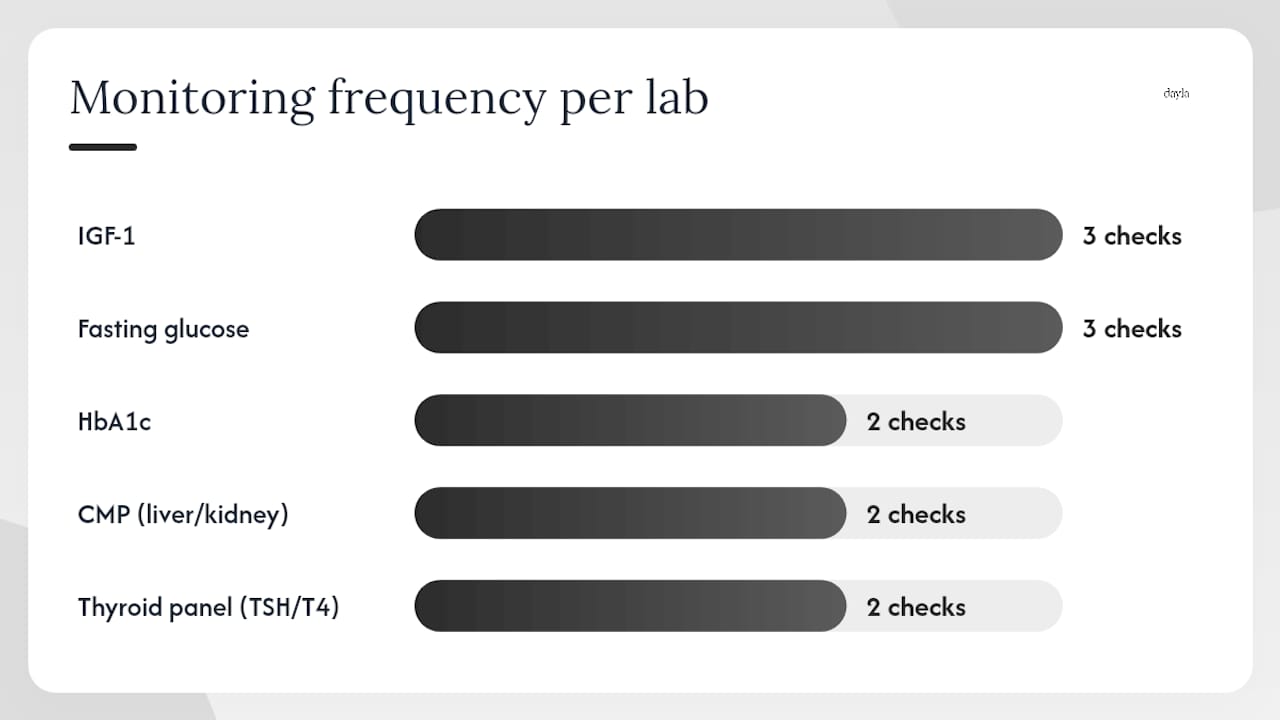
Monitoring is what separates a safe protocol from a risky one. IGF-1 rises quickly after GH-axis stimulation begins, and glucose homeostasis can shift within the first few weeks. Catching either early gives your clinician time to adjust before problems compound.
| Lab / Assessment | Timing | Action threshold |
|---|---|---|
| IGF-1 | Baseline, week 6, end of cycle | Pause or reduce dose if above age-adjusted upper limit |
| Fasting glucose | Baseline, week 6, end of cycle | Investigate if >100 mg/dL from normal baseline; stop if >126 mg/dL |
| HbA1c | Baseline, end of cycle | Flag if any increase from baseline |
| Comprehensive metabolic panel (CMP) | Baseline, end of cycle | Liver and kidney function; flag any out-of-range values |
| Thyroid panel (TSH, free T4) | Baseline, end of cycle | GH affects T4-to-T3 conversion; adjust thyroid medication if applicable |
| Pregnancy test | Baseline (if applicable) | Positive result: do not initiate therapy |
| Blood pressure | Each clinical check | Edema-related hypertension is a stop signal |
When to pause or stop: If IGF-1 exceeds the upper reference range for your age group, reduce the dose by 50% and retest in 4 weeks. If fasting glucose rises above 126 mg/dL, stop the protocol and contact your clinician the same day. Persistent edema that does not resolve within 2 weeks of dose reduction warrants an in-person evaluation.
For practical guidance on reading your lab results, the peptide therapy lab interpretation guide at Daylahealth walks through reference ranges and what each value means in the context of GH-axis therapy.
How long before you see results, and how do you track progress?
Eight weeks is the minimum meaningful trial length. Changes before that point are real but incomplete, and stopping early based on impatience rather than labs is the most common reason people underestimate this stack.
Week-by-week expectations:
- Days 3–7: Deeper sleep, more vivid dreams, and faster sleep onset are often the first signals the protocol is working
- Weeks 1–2: Reduced muscle soreness after training, slightly improved energy on waking
- Weeks 3–4: IGF-1 measurably elevated on labs; some patients notice mild water retention in joints
- Weeks 5–8: Body composition changes begin to appear: modest reduction in subcutaneous fat, slight increase in lean mass
- Weeks 9–12: Most pronounced body-composition changes; recovery metrics at their peak for the cycle
Progress tracking:
- Keep a sleep log (time to fall asleep, wake frequency, subjective quality score)
- Track training performance weekly (weights lifted, reps, perceived exertion)
- Body weight and waist circumference every 2 weeks (scale weight alone is misleading due to water retention)
- IGF-1 at week 6 as the objective mid-cycle checkpoint
- Note any side effects and their timing relative to injection
Individual variation is real. Older adults, those with lower baseline GH, and people with optimized sleep and training tend to see the clearest results. If IGF-1 has not moved at week 6, your clinician may adjust the dose or investigate absorption issues before continuing.
Pairing the cycle with lifestyle changes that support GH response — consistent sleep timing, resistance training, and protein-adequate nutrition — meaningfully amplifies outcomes.
How does Daylahealth approach clinician-supervised peptide therapy?
Daylahealth's peptide program is built around the principle that no protocol is safe without the clinical infrastructure to back it. Every patient starts with a structured online intake, a clinician review of health history and goals, and a baseline lab order before any prescription is written.
What the Daylahealth peptide package includes:
- Online clinical intake and health history review
- Clinician evaluation and lab review before prescribing
- Personalized prescription with dose and cycle length calibrated to your labs, age, and goals
- Compounded peptides shipped nationwide, with options for injectable, microdose, and needle-free oral delivery
- Ongoing care coaching and follow-up cadence built into the subscription
- No insurance required; direct-pay, transparent pricing
A typical first prescription follows the standard initiation protocol: 100 mcg CJC-1295 no-DAC + 100–200 mcg ipamorelin, once daily pre-bed, with a 6-week IGF-1 recheck built into the follow-up schedule. Clinicians adjust dose and frequency based on that lab result and the patient's reported response. Patients with specific performance goals, or those who have completed a first cycle, may be moved to a twice-daily protocol or an extended 16-week cycle with clinician approval.
Safety and follow-up checklist:
- Baseline labs completed before shipment
- 6-week mid-cycle check-in (labs + symptom review)
- End-of-cycle assessment before any repeat prescription
- Emergency contact protocol: patients have direct access to clinical staff for urgent concerns between scheduled check-ins
Key Takeaways
The most effective and safe CJC-1295 + ipamorelin protocol starts at 100 mcg of each peptide pre-bed, runs 8–12 weeks on with a 4-week break, and requires baseline IGF-1 and glucose labs before the first injection.
| Point | Details |
|---|---|
| Starting protocol | 100 mcg CJC-1295 no-DAC + 100–200 mcg ipamorelin, subcutaneous, pre-bed, once daily |
| Cycle structure | a cycle period followed by a break period; extend to 16 weeks only under clinician review |
| Highest-yield lab | IGF-1 at baseline and week 6 is the clearest objective signal that the protocol is working |
| Timing principle | Pre-bed, fasted injection amplifies the nocturnal GH pulse; eating within 2 hours blunts response |
| Daylahealth option | Daylahealth provides clinician-supervised prescribing, compounded peptides, and nationwide shipping with no insurance required |
The case for supervised protocols over DIY sourcing
The conventional wisdom in online peptide communities is that self-sourcing is a reasonable shortcut. It is not. The gap between a research-grade peptide ordered from an unverified supplier and a compounded peptide dispensed by a licensed pharmacy is not a matter of price. It is a matter of sterility testing, accurate concentration, and the absence of contaminants that a standard vial inspection cannot detect.
What most people underestimate is how much the monitoring component matters, not just for safety but for results. A patient who starts at 100 mcg and never checks IGF-1 at week 6 has no way of knowing whether the protocol is working, whether the dose needs adjustment, or whether they are running above the reference range without symptoms. That information gap is where the real risk lives, not in the injection itself.
The no-DAC pre-bed default is the right starting point for most adults because it respects the body's own GH rhythm rather than overriding it. DAC's convenience is real, but the pulsatile pattern that no-DAC preserves is what makes GH therapy feel physiologic rather than pharmacologic. For patients who want the benefits of GH-axis stimulation without the hormonal bluntness of a continuous bleed, no-DAC is the more precise tool.
Daylahealth's model reduces the DIY risk by keeping the clinical layer intact: a real clinician reviews your labs, writes a real prescription, and stays available when something changes. That structure is not bureaucratic overhead. It is what makes the protocol appropriate rather than experimental.
Clinician-supervised peptide therapy through Daylahealth
Prescription peptides without the guesswork of unverified sourcing: Daylahealth connects you with a licensed clinician who reviews your labs, writes a personalized prescription, and ships compounded CJC-1295 + ipamorelin directly to your door, nationwide.

The package includes your clinical intake, baseline lab review, a personalized dosing protocol, and ongoing care coaching, all under one subscription with no insurance required. Delivery options include injectable, microdose, and needle-free oral formats depending on your prescription.
To get started, visit the Daylahealth peptide program and complete the online intake. A clinician will review your information and reach out with next steps, typically within one business day.
Useful sources
The following peer-reviewed and institutional references support the clinical claims in this guide. This article is educational and does not constitute medical advice. Consult a licensed clinician before initiating any peptide therapy.
- ncbi.nlm.nih.gov
- pubmed.ncbi.nlm.nih.gov
- cancer.gov
- CJC-1295 Dosage & Administration | Peptides Insider
- CJC-1295 Dosage: Complete Protocol Guide | PeptidesExplorer
- CJC-1295 + Ipamorelin Peptide Dosing Guide: Protocol, Timing & Cycle (2026)
- mayoclinic.org