

Exercise alone is defined as a weight loss strategy that consistently underdelivers because the body actively works against the calorie deficit you create. Research shows that exercise-only regimens produce just 2–3 kg of weight loss over six months, even when people burn more than 2,000 calories per week through training. The reason why exercise alone rarely causes weight loss comes down to two powerful biological forces: metabolic compensation and appetite increases. Your body treats a calorie deficit as a threat and responds by cutting energy use elsewhere and driving you to eat more. Understanding these mechanisms is the first step toward building a plan that actually works.
Why exercise alone rarely causes significant weight loss
The body does not treat exercise as a simple math equation. When you burn more calories through physical activity, your physiology adjusts to protect its energy reserves. This is called metabolic compensation, and it is the primary reason exercise alone results in far less weight loss than most people expect.
Two mechanisms drive this compensation. First, the body reduces its resting metabolic rate. Metabolic adaptation to training includes measurable reductions in the size of metabolically active organs like the liver and kidneys. Smaller organs burn fewer calories at rest, which directly offsets the energy you spent at the gym. Second, the body reduces non-exercise activity, meaning you unconsciously move less throughout the day after a hard workout.

Appetite is the second major force working against you. About 50% of calories burned during exercise are offset by increased food intake afterward. This is not a willpower failure. It is a biological response driven by hunger hormones that rise after sustained physical activity. The result is a calorie deficit that is far smaller than your workout log suggests.
Evolutionary biology explains why this happens. Humans are biologically wired to conserve energy, and exercise triggers compensatory hunger and reductions in spontaneous movement. Your body evolved to survive scarcity, not to lose fat on a treadmill.
- Reduced resting metabolic rate: Organ size decreases and basal metabolic processes slow after consistent training.
- Lower non-exercise activity: You sit more, fidget less, and move less casually throughout the day.
- Increased appetite: Hunger hormones rise after exercise, driving calorie intake up.
- Subconscious compensation: Many of these adjustments happen without any awareness on your part.
Pro Tip: Track your total daily steps and non-exercise movement alongside your workouts. If your step count drops significantly on training days, metabolic compensation is already at work.
Does combining diet with exercise produce better results?
The research answer is unambiguous. Combined diet and exercise programs produce significantly more weight loss and fat mass reduction than exercise alone over 12 months. Meta-analyses consistently show that adding dietary control to a training program surpasses what either approach achieves on its own.
The magnitude of the difference is clinically meaningful. Combined programs yield about 5–6 kg more weight loss than exercise alone after one year. That gap represents the difference between a visible body composition change and a frustrating plateau. Structured behavioral components, such as meal planning, calorie tracking, and regular check-ins, amplify these results further.
The table below shows how different intervention types compare on weight loss outcomes at 12 months.
| Intervention type | Typical weight loss at 12 months |
|---|---|
| Exercise alone | 2–3 kg |
| Diet alone | 4–6 kg |
| Combined diet and exercise | 8–10 kg |
| Combined with behavioral support | 10+ kg |
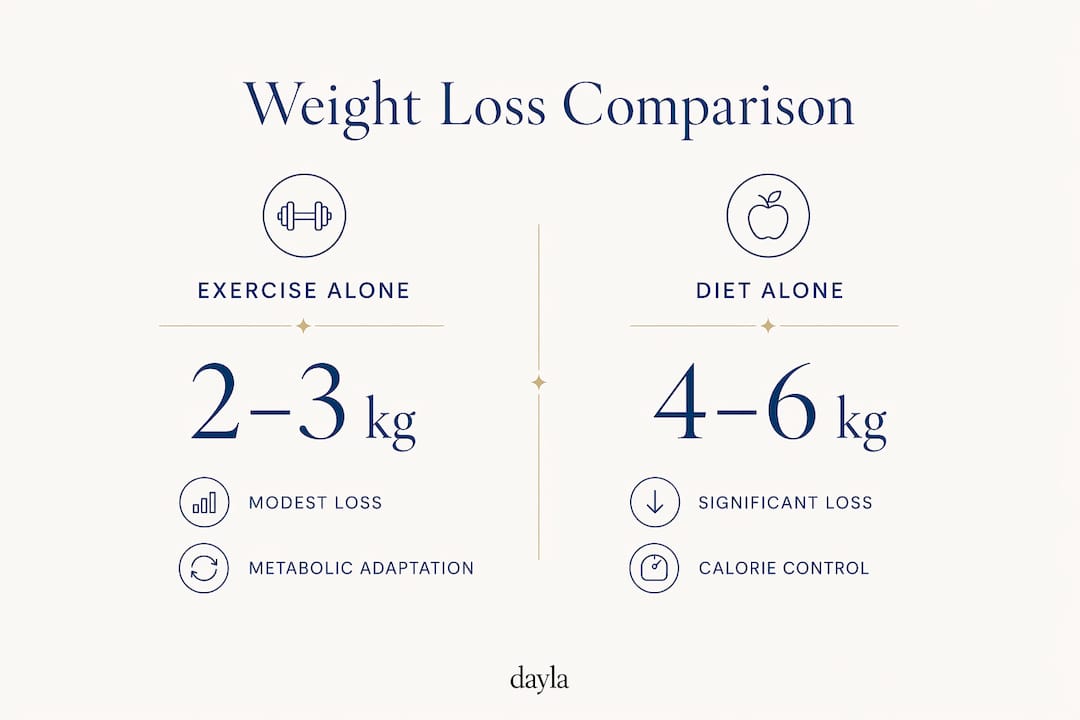
Diet controls the calorie deficit. Exercise preserves muscle, improves metabolic health, and supports long-term weight maintenance. Neither works as well without the other. If you want lasting weight loss results, the evidence points clearly toward combining both.
Which exercise types work best for fat loss?
Not all exercise delivers equal fat loss benefits. The type, intensity, and volume of training each affect how much visceral fat you lose and how well your metabolism responds. Choosing the right modality matters, especially when you are also managing calorie intake.
High-Intensity Interval Training (HIIT)
HIIT is the most effective single modality for reducing visceral adipose tissue. HIIT achieves visceral fat reduction at approximately 400 MET-minutes per week, a lower volume than what aerobic or resistance training requires for the same effect. That efficiency matters when time is limited. A 20-minute HIIT session three times per week can produce measurable reductions in the dangerous fat stored around your organs. For a deeper look at targeting visceral fat specifically, the visceral fat reduction guide at Daylahealth covers current strategies in detail.
Combined aerobic and resistance training
Pairing cardio with weight training produces better outcomes than either alone. Aerobic exercise burns calories during the session. Resistance training builds muscle, which raises resting metabolic rate and directly counters the metabolic compensation described earlier. Resistance training elevates energy expenditure beyond the body's compensatory adaptations, making it a critical tool for anyone trying to lose fat without losing muscle. Understanding muscle loss during weight loss is worth your attention if you are cutting calories alongside training.
Exercise benefits beyond the scale
Exercise improves insulin sensitivity and reduces visceral fat even when the number on the scale barely moves. These metabolic health improvements lower the risk of type 2 diabetes, cardiovascular disease, and metabolic syndrome. The scale is a poor measure of what exercise actually does for your body. Body composition, blood glucose, and blood pressure tell a more complete story.
- HIIT: Best for visceral fat reduction at low weekly volume.
- Resistance training: Builds muscle, raises resting metabolic rate, counters compensation.
- Aerobic training: Supports cardiovascular health and calorie burn during sessions.
- Combined modalities: Produce the greatest improvements in fat mass and metabolic markers.
Practical strategies to maximize weight loss beyond exercise
The calorie deficit is the non-negotiable foundation of fat loss. Exercise contributes to that deficit, but diet controls it. Cutting 300–500 calories per day through food choices is far more reliable than trying to burn the same amount through additional workouts, because the body cannot compensate for dietary restriction as easily as it compensates for exercise.
- Control calories through diet first. Prioritize protein and fiber to manage hunger. These nutrients reduce the appetite spikes that follow exercise and help you maintain a deficit without feeling deprived.
- Add resistance training to your routine. Lifting weights two to three times per week preserves muscle during a calorie deficit and keeps your resting metabolic rate from dropping. This directly counters metabolic compensation.
- Avoid compensatory sedentary behavior. After a workout, make a conscious effort to stay active throughout the day. Walk during phone calls, take stairs, and avoid long sitting sessions.
- Track body composition, not just weight. Use measurements, progress photos, or body fat assessments to capture the full picture of your progress. Focusing on health markers rather than scale weight leads to better adherence and a more accurate view of results.
- Reframe your relationship with exercise. Movement is medicine for your metabolic health, cardiovascular system, and mental wellbeing. When you exercise for health rather than purely for weight loss, you are more likely to stay consistent long-term.
Pro Tip: Weigh yourself at the same time each morning after using the bathroom. This reduces daily fluctuation noise and gives you a cleaner weekly trend to evaluate.
Key takeaways
Exercise alone produces modest weight loss because the body compensates through metabolic adaptation and appetite increases, making dietary control the essential partner to any effective training program.
| Point | Details |
|---|---|
| Exercise alone underdelivers | Exercise-only regimens produce just 2–3 kg of weight loss over six months on average. |
| Metabolic compensation is real | The body reduces resting metabolic rate and non-exercise activity to offset calories burned. |
| Diet controls the deficit | Combining diet with exercise yields 5–6 kg more weight loss than exercise alone at 12 months. |
| HIIT targets visceral fat efficiently | HIIT reduces visceral adipose tissue at lower weekly volumes than other exercise modalities. |
| Resistance training counters adaptation | Building muscle raises resting metabolic rate and directly fights metabolic compensation. |
The uncomfortable truth about exercise and weight loss
Most people start an exercise program expecting the scale to move within weeks. When it does not, they assume they are doing something wrong. The reality is that the body is doing exactly what it evolved to do: protect its energy stores.
What I find most telling is how consistently this pattern shows up. People double their workout frequency, see no change on the scale, and conclude that exercise does not work for them. The exercise is working. The problem is that the body is quietly canceling out most of the calorie deficit through hunger and reduced movement. The scale does not capture any of the real benefits happening underneath.
Exercise's greatest value lies in long-term metabolic health and muscle preservation, not short-term weight loss. Insulin sensitivity, visceral fat reduction, cardiovascular fitness, and mood regulation are all genuine outcomes of consistent training. None of them show up on a bathroom scale.
The shift I recommend is this: use diet to create the calorie deficit, use exercise to protect your muscle and metabolic health, and consider medically supervised options like GLP-1 therapies when lifestyle changes alone are not enough. GLP-1 medications directly address appetite and metabolic compensation, the two forces that make exercise-only approaches so frustrating. That combination of medical support and structured lifestyle change is where the most meaningful results happen.
— Flexible
Weight management support from Daylahealth
If you have been exercising consistently without seeing the results you expected, the issue is not your effort. It is the strategy.

Daylahealth offers doctor-led GLP-1 weight loss programs that directly address the appetite and metabolic compensation that make exercise-only approaches fall short. GLP-1 therapies work by reducing hunger signals and supporting a sustained calorie deficit, the exact mechanism that exercise alone cannot reliably produce. Daylahealth also offers peptide therapies designed to support metabolic health and body composition alongside your lifestyle program. Every plan is personalized and medically supervised, so you get clinical precision alongside the convenience of direct-to-consumer access.
FAQ
Why doesn't exercise cause more weight loss?
The body compensates for exercise by reducing resting metabolic rate and increasing appetite, which offsets a large portion of the calories burned. Studies show that about 50% of exercise-burned calories are replaced through increased food intake.
How much more weight do you lose by combining diet and exercise?
Combined diet and exercise programs produce approximately 5–6 kg more weight loss than exercise alone over 12 months. That difference reflects the body's inability to compensate for dietary restriction as effectively as it compensates for exercise.
What is the best exercise for fat loss?
HIIT is the most efficient modality for reducing visceral fat, achieving meaningful results at lower weekly volumes than aerobic or resistance training alone. Combining HIIT with resistance training produces the best outcomes for both fat loss and metabolic health.
Does exercise have benefits even without weight loss?
Exercise improves insulin sensitivity, reduces visceral fat, and lowers cardiovascular disease risk even when scale weight changes are minimal. These metabolic health benefits are clinically significant and occur independently of weight loss.
What is metabolic compensation in weight loss?
Metabolic compensation is the body's response to increased exercise, including reductions in resting metabolic rate, organ size, and non-exercise movement. This adaptation limits the total calorie deficit that exercise alone can create.