
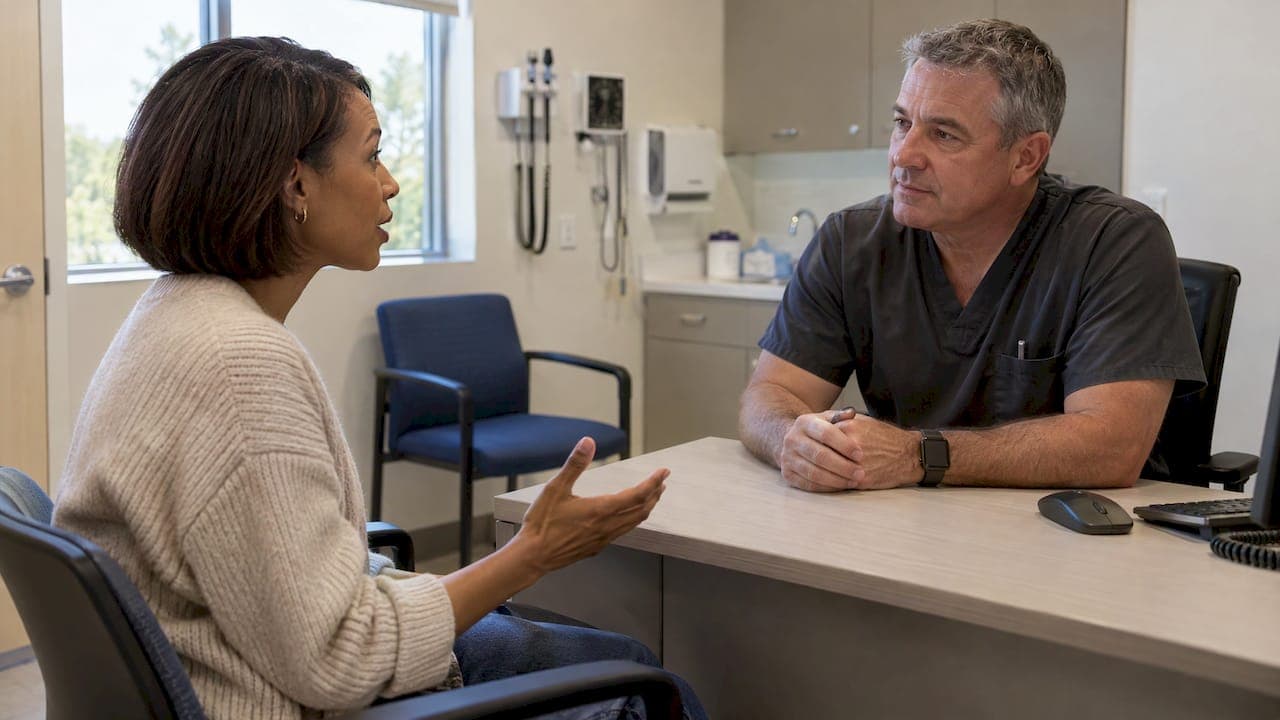
If you take semaglutide and have surgery scheduled, tell your surgeon and anesthesiologist as early as you can, and ask them for a written plan. Current U.S. guidance says most patients can continue a GLP-1 medication before elective surgery. The decision is made jointly, and the plan depends on your dose, your dosing schedule and your symptoms. Some patients are asked to hold a weekly dose for a week, or to follow a liquid diet the day before. This guide explains why, what the societies recommend, and how to prepare.
TL;DR
- Semaglutide slows stomach emptying. Under general anesthesia or deep sedation, food left in the stomach can be regurgitated and inhaled.
- Multisociety guidance from 2024 says most patients can continue GLP-1 medications before elective surgery. The patient and care team decide together.
- If your team does ask you to hold it, the original ASA approach is to skip the weekly dose for the week before surgery. Daily formulations are held on the day of surgery.
- Some patients follow a clear liquid diet for 24 hours beforehand. Hospitals set their own rules, so follow the written instructions you are given.
- Never stop or restart semaglutide on your own. Tell every member of your surgical team about it, including how long you have taken it and your current dose.
Table of Contents
- Why semaglutide matters to anesthesia teams
- What current guidance says: hold or continue?
- Comparing the common approaches
- Fasting and liquid diets before surgery
- What to tell your surgeon and anesthesiologist
- A week-by-week prep timeline
- Restarting semaglutide after surgery
- Our perspective
- Your GLP-1 care, with clinical oversight
- FAQ
- Sources
Why semaglutide matters to anesthesia teams
Semaglutide works partly by delaying gastric emptying. Food takes longer to leave the stomach and move into the small intestine. That is part of why you feel full sooner. It is also the reason anesthesia teams ask about it.
According to UT MD Anderson, leftover stomach contents can raise the risk of regurgitation and aspiration into the airways and lungs during general anesthesia and deep sedation. Aspiration can lead to pneumonia and other serious complications. Their anesthesiologist explains that when you are sedated, you may be unable to turn your head if you vomit, so food particles and stomach acid can reach the lungs.
The usual fasting rules were built for people whose stomachs empty at a normal pace. Semaglutide can change that, so a fasting time that works for most patients may not be enough for you.
A case report in the American Journal of Medicine shows how this looks in practice. A patient started semaglutide 1 mg the week before a gastroscopy and fasted for 13 hours, yet the stomach was full of solid food. Three months later, with semaglutide withheld for three weeks, the stomach was empty after 12 hours of fasting. It is one case, not a rule, but it explains why teams ask careful questions.
This is a safety measure, and it is not a judgment on your treatment. GLP-1 medications are common. The ASA notes that about one in eight U.S. adults use a GLP-1 drug for diabetes, weight loss or heart problems, so anesthesia teams see these patients every day.

What current guidance says: hold or continue?
The advice has changed since 2023, and that is why search results disagree. Some pages tell you to stop two or three weeks ahead. Others say one week. The latest U.S. guidance is more individual.
The 2023 ASA guidance: hold for a week
The ASA's 2023 guidance said weekly semaglutide should be withheld for a week before anesthesia. This was based on its roughly seven-day half-life, as described in a 2024 report of two aspiration cases. Many clinic pages still repeat this advice.
The 2024 multisociety guidance: decide together
In October 2024, several societies published updated guidance. The ASA announcement states that most patients can continue GLP-1 receptor agonists before elective surgery. The patient and care team weigh the need for the medication against individual risk. The factors the guidance lists include:
- the escalation phase, when the dose is being raised
- a higher dose
- weekly dosing
- GI symptoms such as nausea, vomiting, bloating or abdominal pain
- other conditions that may delay gastric emptying
The full multisociety guidance adds that weekly dosing is associated with more GI side effects than daily formulations, which raises the risk of delayed emptying. It also says that holding the medication only because a patient has overweight or obesity, with no specific indication, could amount to weight bias. That bias should be avoided.
If your team asks you to hold
The same guidance says that if the care team recommends holding, it should follow the original ASA approach. Daily formulations are held on the day of surgery. Weekly formulations are held for a week before. A 2025 review in the Journal of Bone and Joint Surgery repeats this. It adds that if you have GI symptoms on the day of surgery, the team may delay the procedure or proceed with full-stomach precautions.
Some anesthesiology authors have argued for a more cautious line. A 2023 opinion paper suggested considering three half-lives for weight-loss use, which is about three weeks for semaglutide. The authors presented this as opinion, not a clinical guideline. Some surgeons still ask for two or three weeks, so your own surgeon's instruction is the one that counts.
The escalation phase matters
When you start semaglutide, the dose rises in steps. The ASA says this phase typically lasts four to eight weeks. Elective surgery should ideally be deferred until it has passed and GI side effects have settled. If you are early in treatment and your surgery date is flexible, raise this with your surgeon.
Comparing the common approaches
| Approach | What it means | Where it comes from |
|---|---|---|
| Continue as usual | Take your dose, with the team aware and a plan for fasting | 2024 multisociety guidance, for most patients at lower risk |
| Hold one week (weekly dose) | Skip the weekly injection in the week before surgery | Original ASA approach, still used if the team advises holding |
| Hold the day of surgery (daily dose) | Skip that morning's dose | Original ASA approach for daily formulations |
| Liquid diet for 24 hours | Clear liquids only the day before | Option for higher-risk patients |
| Hold about three weeks | Three half-lives of semaglutide | Opinion paper (2023), not a guideline |
None of these is for you to choose alone. Your anesthesiologist picks the approach based on your procedure, your dose and how you feel.
Fasting and liquid diets before surgery
The classic ASA fasting rule is often called 2-4-6-8. It allows clear liquids up to 2 hours before surgery, breast milk up to 4, a light meal up to 6, and heavy fatty foods up to 8 hours or more. These rules were created for people with normal gastric emptying.

For patients on GLP-1 drugs, many hospitals add steps. The multisociety guidance says a liquid diet for at least 24 hours before the procedure can be used when there is concern about delayed gastric emptying, as is done for colonoscopy and bariatric surgery.
The instructions differ by institution. UT MD Anderson describes two paths:
- Last dose more than 30 days ago: a standard diet the day before, and nothing to eat or drink after midnight.
- Last dose 30 days ago or less: a clear liquid diet starting at 8 a.m. the day before, and no eating or drinking for two hours before arrival.
The same source reports that Memorial Sloan Kettering uses a clear liquid diet from 6 a.m. the day before and stops food and drink 8 hours before arrival. The ASA's patient site, Made for This Moment, tells patients to avoid solid food for 24 hours before surgery, with clear liquids allowed until two hours before.
These differences are normal. They show that each hospital sets its own protocol, so use the sheet your own facility gives you.
What counts as a clear liquid
Your pre-op instructions will have a precise list. Clear liquids are generally those you can see through, such as water, clear broth and plain gelatin. Ask your team about specific items like coffee with milk, protein shakes or juice with pulp, which often are not allowed.
Practical tips for the liquid-diet day
- Plan it a few days ahead. Buy clear broth, gelatin and electrolyte drinks that meet your hospital's list.
- Sip steadily. GLP-1 users may already drink less because of appetite changes, and dehydration makes nausea worse.
- Call the surgical office if you feel nauseated, bloated or start vomiting. These symptoms can change the plan.
- Do not take extra steps like skipping fluids you are allowed to have.
If constipation is part of your routine on semaglutide, review our constipation plan for GLP-1 users before a liquid-diet day, and raise bowel prep questions with your team.
What to tell your surgeon and anesthesiologist
The ASA's patient guidance says to tell your surgical team and anesthesiologist about every GLP-1 medication you take, plus all other medications and supplements. Say if you also take a GIP medication alongside a GLP-1 drug.
The UK regulator MHRA makes a point worth borrowing. Its drug safety update notes that anesthetists should consider that patients may have bought these medicines for weight loss and may not mention them unless asked. Mention yours before you are asked.
Bring this list to your pre-op appointment:
- The medication name and form: injection, microdose, sublingual or oral.
- Your current dose and the date of your last dose.
- Your dosing day each week.
- When you last increased your dose.
- Any nausea, vomiting, bloating, reflux or constipation in recent weeks.
- Your prescriber's contact information.
If you are treated through an online program like ours, tell your Dayla Health clinician your surgery date as soon as it is set. Your clinician can coordinate with your surgical team and adjust your plan.
There is also a related situation. If you have a procedure involving sedation, such as an endoscopy, the same logic applies. Read our guide to semaglutide before a colonoscopy. Our overview of current guidance on stopping semaglutide before surgery covers the topic from another angle.
A week-by-week prep timeline
This is a way to organize questions, not medical instructions. Your team's written plan replaces it.
Several weeks before
Tell your surgeon about semaglutide at the first consult. If you are still raising your dose, ask whether the date can wait until the escalation phase has passed. Ask who will decide about your dose: the surgeon, the anesthesiologist or your prescriber.
One to two weeks before
Get the written instructions for your dose and your fasting. Confirm your injection day and write down what to do with the dose that falls closest to surgery. Stock up on approved clear liquids.
The day before
Follow the diet exactly as written. If your team asked for a liquid diet, start at the time given. Keep hydrated within the rules. Report any vomiting or nausea right away.
The day of surgery
Stop food and drink at the time you were told. Take only the medications you were told to take. Repeat your medication list to the nurse and anesthesiologist. If you feel nauseated or full, say so. The team may use extra precautions, such as treating your stomach as full, or checking it with ultrasound. The JBJS review lists point-of-care gastric ultrasound as one such tool.
Restarting semaglutide after surgery
Restart timing is set by your surgeon and prescriber, not by a universal rule. Our research found no national guideline with a fixed number of days. Care teams commonly look for signs that your digestion has recovered: you are eating and drinking normally and are free of nausea, vomiting and dehydration. Some surgeries, such as those involving the stomach or intestines, need a specific plan from the surgical team.
Before you leave the hospital, ask:
- On what day may I take my next dose?
- What symptoms should make me delay it?
- Should I resume at my prior dose or a lower one after a long gap?
- Who do I call if nausea or vomiting returns?
A longer break can change how you tolerate the medication, so let your clinician set the restart dose. While you recover, focus on protein and fluids. Our guide to semaglutide foods and the role of diet in GLP-1 treatment give practical ideas for gentle, nutrient-dense meals.
Our perspective
We see surgery planning as a moment where good communication protects you. The safest patients are not those who stop treatment on their own. They are the ones whose care teams know exactly what they take and when.
That is why we build care around doctor-led oversight. Your Dayla Health clinician can document your medication, dose and last injection date, and share that information with the surgical team you choose. Our dietitian visits are free, which helps when you need a plan for liquid-diet days or recovery nutrition.
We offer personalized GLP-1 care in several forms, including injection, microdose and needle-free oral delivery, so your clinician can look at what fits your schedule, including the weeks around a procedure. Flexible cancellation and cash pricing without membership fees mean a pause for surgery does not need to be a financial worry.
Flexible
Your GLP-1 care, with clinical oversight
If you want a doctor-led program that keeps your care team informed when life events like surgery come up, Dayla Health offers GLP-1 weight loss treatment shipped nationwide. Plans include clinician evaluation, medication, dietitian consults and care coaching, with no insurance required.
Current plans on our site start at $149 per month for Oral GLP · Liposomal, $159 per month for GLP-1 Microdose and $179 per month for GLP-1 Injection. The dayla GLP-1 program is $299 per month. You can also view our semaglutide injection maintenance dose or semaglutide sublingual drops. A clinician approves every prescription after an online intake.
FAQ
Does semaglutide react with anesthesia?
It does not react chemically in the way two drugs can interact. The concern is delayed stomach emptying, which can leave food in the stomach during anesthesia and raise the risk of aspiration. Tell your anesthesiologist about your dose so they can plan fasting and precautions.
Is it necessary to hold GLP-1 agonists before surgery?
Not always. The 2024 multisociety guidance says most patients can continue them before elective surgery, with the decision made jointly. Holding may be advised if you are in the escalation phase, on a higher dose, or have GI symptoms. Follow your own team's written plan.
What is the 2-4-6 rule for anesthesia?
It is the ASA's fasting rule, often written 2-4-6-8. Clear liquids are allowed up to 2 hours before surgery, breast milk up to 4, a light meal up to 6, and heavy fatty foods up to 8 hours or more. Semaglutide can slow emptying, so your team may add a liquid diet or longer fasting.
How long before surgery should I stop semaglutide?
If your team asks you to hold it, the ASA approach is to skip the weekly dose for the week before surgery. Some surgeons ask for longer, up to three weeks, based on semaglutide's half-life. Your surgeon's instruction decides, so ask for it in writing.
When can I restart semaglutide after surgery?
Your surgeon and prescriber decide, usually once you are eating and drinking normally without nausea or vomiting. Ask for a restart date and dose before you leave the hospital.
Sources
- UT MD Anderson: GLP-1s and anesthesia, what to know before surgery
- American Journal of Medicine: delayed gastric emptying with perioperative semaglutide
- ASA: most patients can continue GLP-1 medications before surgery
- Multisociety clinical practice guidance for the safe use of GLP-1 receptor agonists
- JBJS: GLP-1 receptor agonists in orthopaedic surgery
- Pulmonary aspiration of gastric contents in two patients taking semaglutide
- Anesthesia and glucagon-like peptide-1 receptor agonists: clinical opinion
- ASA Made for This Moment: drugs for diabetes or weight loss
- MHRA drug safety update on GLP-1 receptor agonists and aspiration