
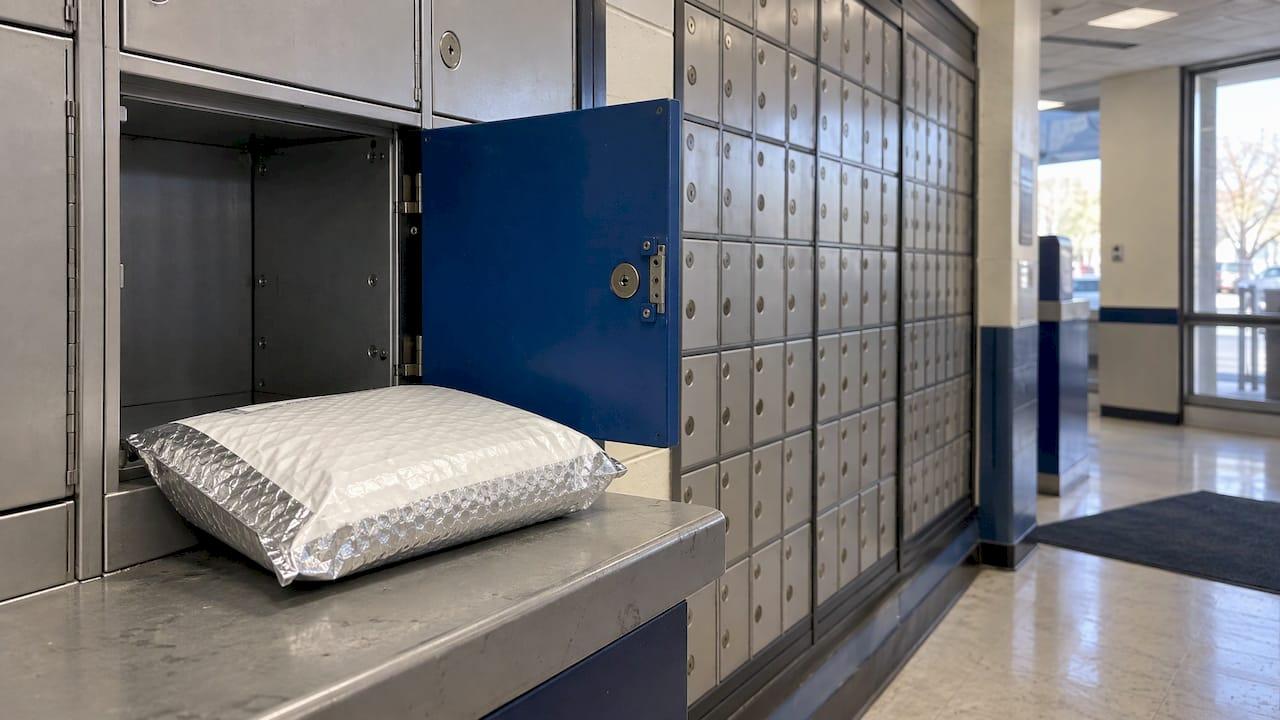
Prescription medication can sometimes be mailed to a PO box, but it is the least reliable way to receive it. Federal mail rules limit who may mail prescription drugs. Many programs ship only to a street address, and temperature-sensitive or signature-required medication usually cannot go to a PO box at all. If you take or plan to start a GLP-1 medication, set up a delivery address where a person can receive and sign for the package. This guide explains why, what the rules say, and what to do if a PO box is your only mailing address.
TL;DR
- Federal mail rules let authorized dispensers, such as pharmacies and medical practitioners, mail prescription medicine to patients under their care. Each program then sets its own delivery limits.
- One federal mail-order program states that it cannot send insulin or other refrigerated medication to a PO box. Refrigerated medication and a PO box are a poor match in general.
- Signature delivery requires a person aged 21 or older at a street address. A PO box cannot meet that requirement for carrier deliveries.
- If you only receive mail at a PO box, USPS offers a street addressing service for Premium PO Box customers that lets private carriers deliver to the post office.
- Plan your delivery address before your first shipment so your treatment is not delayed.
Table of Contents
- Can medication be shipped to a PO box?
- Why a PO box is a poor fit for prescription medication
- Signature required medication delivery: how it works
- What to do if you only have a PO box
- Is it illegal to mail prescription drugs?
- Delivery checklist for GLP-1 patients
- Delivery, simplified with Dayla
- Our perspective
- Safety notes that apply to every delivery
- FAQ
- Sources
Can medication be shipped to a PO box?
The short answer is that the law does not forbid it outright, but the practical answer is usually no.
USPS publishes the rules in Publication 52, section 453. Controlled substances and drugs that contain them are mailable only under set conditions. Both the mailer and the addressee must be registered with the Drug Enforcement Administration (DEA) or exempt from registration. The other route is prescription medicine containing mailable narcotics, sent by manufacturers, their registered agents, pharmacies, medical practitioners or other authorized dispensers. Nonnarcotic prescription medicines may be mailed by pharmacists and medical practitioners to patients under their care.
So the mail system itself allows a licensed dispenser to mail your prescription. The limits come from what happens next. The dispenser decides how to ship, which carrier to use and which addresses it accepts. USPS also says the mailer carries full responsibility for complying with federal, state and local distribution laws, which pushes dispensers toward conservative delivery rules.
That is why different programs give different answers. One federal example: the VA's Meds by Mail program for family member programs sends non-urgent regular prescriptions to a home. It states that it cannot mail insulin or other refrigerated medication to a PO box. The same page notes it cannot send refrigerated or flammable medication to most addresses outside the continental United States, with exceptions for Alaska, Hawaii and Puerto Rico.
The pattern is clear. A PO box may work for a shelf-stable, non-controlled prescription from a dispenser that accepts PO boxes. It rarely works for anything that needs cold storage, adult signature or a delivery attempt by a private carrier.
Why a PO box is a poor fit for prescription medication
Three features of a PO box work against medication delivery.
Private carriers do not deliver to PO boxes
USPS operates PO boxes. UPS and FedEx drivers deliver to street addresses. Many prescription shipments travel by private carrier, so a package addressed to a PO box has no workable route. That is the reason USPS created a street-addressing option, covered below.
Temperature matters
Many injectable medications must stay in a set temperature range. Semaglutide pens, for example, are typically stored refrigerated. Our guide to semaglutide storage temperature covers the 36 to 46°F range and how to handle travel. A package that waits in a post office box, or in a postal facility while you are away, spends longer outside that range than one handed to you at your door.
Regulators treat this as a patient-safety issue. Missouri's prescription delivery rule, 20 CSR 2220-2.013, took effect December 31, 2024. It requires pharmacies that deliver by mail or common carrier to make a reasonable attempt to notify the patient before shipment. It also requires written instructions on spotting compromised integrity from temperature variation, and policies for suspected temperature excursions.

Signature requirements need a person at an address
A locked PO box cannot sign for anything. We cover signatures in the next section.
Signature required medication delivery: how it works
Some shipments need a signature because the contents are valuable, regulated or sensitive to being left outside. The Texas State Board of Pharmacy's mail delivery standards from its April 2023 board materials say that when a drug is reasonably likely to be compromised if left unattended, the pharmacy should require the patient or an agent to sign. If delivery cannot be made with a signature, the package may not be left unattended. It must be returned to be held for pickup or redelivered at the patient's request. The board's task force explained that documentation helps keep medication out of mailboxes and off doorsteps, where theft and exposure to temperature and humidity extremes can occur.
Adult signature rules
Two terms come up often:
- Adult Signature Required: someone aged 21 or older at the delivery address signs.
- Adult Signature Restricted Delivery: only the named addressee, or an authorized agent aged 21 or older, signs.
USPS describes both in its Quick Service Guide for Adult Signature. They are available to commercial and online customers on Priority Mail Express, Priority Mail and Parcel Select. UPS applies a similar standard. Its signature requirements page says age-verified shipments, including regulated pharmaceuticals, go only to someone at least 21, and an Adult Signature Required package cannot be released with a digital signature.
What happens if nobody is home
The outcome depends on the carrier.
| Carrier | If no one can sign |
|---|---|
| USPS | The carrier leaves a notice and returns the item to the Post Office. You follow the notice or call 1-800-ASK-USPS to arrange redelivery, as described in the Domestic Mail Manual. |
| UPS | UPS may try again the next business day, or you can redirect the package, per its signature page. |
Every missed attempt adds days. For a weekly injection or a daily oral dose, days matter. Choose an address and a delivery window where an adult will be present.
What to do if you only have a PO box
Many people use a PO box because mail is not delivered to their home. Rural routes, shared housing and some island and territory addresses are common reasons. You still have good options.
Use a Premium PO Box street address
USPS offers Premium PO Box Street Addressing to its Premium PO Box customers. It lets you use the Post Office's street address, with your box number written as a unit number (for example, 500 Main Street #59), so UPS, FedEx, DHL and other private carriers can deliver your packages to the post office. The agreement states that this address cannot be used as a legal residence or business address. It also does not turn the post office into a signature point for you, so confirm the delivery terms with your care team before your first shipment.
Use a trusted street address
A workplace, a family member's home or a friend's address can work if an adult aged 21 or older will be there during delivery. Pick someone who will keep the package safe and refrigerate it promptly if it contains injectable medication. Use the person's full name on the order so the carrier matches the label.
Ask for a bridge supply
The VA suggests that patients who need medication before a mail order arrives ask their provider for two prescriptions: a short-term supply for a local pharmacy and one for the mail service. The same approach protects you from gaps if your first shipment is delayed. For GLP-1 therapy, plan ahead on refills too. Our guide to the GLP-1 refill process explains why starting 7 to 10 days early gives time for clinician review.
Is it illegal to mail prescription drugs?
No, not when it is done by an authorized dispenser. USPS states that controlled substances and prescription drugs are mailable by DEA-registered distributors, such as medical practitioners and pharmacists, who may send them to patients under their care. Its FAQ points to Publication 52, section 453 for details.
The rules fall on the sender. Under section 453.4, controlled-substance inner packaging must be marked and sealed under the Controlled Substances Act. It must carry the prescription number and the name and address of the dispensing pharmacy or practitioner. It also goes in a plain outer wrapper with no markings that indicate the contents. Non-controlled mailable drugs also travel in a plain outer wrapper.
Two points matter to you as a patient:
- Do not mail your own medication to someone else. Only authorized dispensers may mail prescription medicine. Passing a prescription to a family member by mail is not covered by those permissions. USPS limits transfers of unused pharmaceuticals to authorized collectors in mail-back programs, as its DMM Advisory explains.
- Packaging may look plain. A discreet outer wrapper is a legal requirement, not a sign that something is wrong.
Delivery checklist for GLP-1 patients
GLP-1 therapy is a steady routine. The medication needs to arrive on time, at the right temperature, with someone to receive it. Before your first shipment:
- Confirm the address type. Use a street address where a carrier can deliver and an adult can sign.
- Check who will be there. Pick a window when someone aged 21 or older is present, or choose an address where one always is.
- Plan the refrigerator. If your medication is an injection, clear a space and have a place to put it the moment it arrives.
- Track your supply. Count remaining doses and request your refill early so a missed delivery does not leave you without medication.
- Tell your care team about changes. If you move, travel or change addresses, say so before your next shipment is prepared.
- Keep your contact details current. Carrier notices and clinician messages reach you only if your phone and email are right.
If you are still working out how the process begins, our guide on how to get a GLP-1 prescription online walks through intake, clinician review and approval.
Delivery, simplified with Dayla
We built dayla around doctor-led, personalized GLP-1 care that is shipped nationwide. Your plan includes clinician evaluations, medication, care coaching and shipping in one monthly price, with no insurance requirements. Dietitian visits are free, and cancellation is flexible.
You can choose the delivery form that suits your routine:
- GLP-1 Injection: from $179 per month
- GLP-1 Microdose: from $159 per month
- Oral GLP · Liposomal: from $149 per month, a needle-free option
- dayla GLP-1 program: $299 per month
See the plans on the dayla homepage, or look at the semaglutide sublingual drops if a needle-free option appeals to you.
Because your clinician access is nationwide, your care team is the place to settle delivery questions before your first shipment, so the plan you start is the plan you can receive.
Our perspective
Delivery is part of treatment. A GLP-1 medication works only when it reaches you on schedule, in good condition, and in the hands of the person it is prescribed for.
That is why we think about shipping as part of care, not an afterthought. Your plan bundles the clinician evaluation, the medication, care coaching and shipping into one cash price, so you are not assembling the pieces yourself. Dietitian visits are free, and you can choose an injection, a microdose or a needle-free oral option that fits the way you live.
Our advice is simple. Choose a delivery address where an adult can receive the package, tell your care team about any change, and refill early. If you are still deciding on a form of GLP-1 therapy, we would rather you pick the one you can receive and take consistently than the one that looks best on paper.
Flexible
Safety notes that apply to every delivery
- Inspect the package on arrival. If injectable medication feels warm, or the packaging is damaged, contact your care team before using it. Do not use medication you believe was exposed to heat or freezing.
- Store it right away. Follow the storage instructions that come with your medication. For semaglutide pens, our storage guide covers the 36 to 46°F range.
- Know what you are receiving. Compounded medication comes from licensed pharmacies that follow specific standards. Our overview of 503A and 503B compounding pharmacy standards explains what those standards mean.
- Check your state. Rules on compounded GLP-1 access differ by state, as we explain in State Rules Decide U.S. Compounded GLP-1 Access in 2026.
- Talk to your doctor or pharmacist about interactions and side effects. If you take other medications, have a medical condition, are pregnant or plan to become pregnant, your clinician must review your plan before you start.
FAQ
Can medication be shipped to a PO box?
Sometimes. Federal mail rules allow authorized dispensers to mail prescription medicine to patients, but each program sets its own address limits. One federal mail-order program says it cannot send refrigerated medication to a PO box. For temperature-sensitive medication, use a street address.
What cannot be shipped to a PO box?
That depends on the sender. Private carriers do not deliver to PO boxes, and signature-required packages need a person at a street address. Refrigerated medication and controlled substances face the tightest limits. Check the delivery terms with your care team before you order.
Is it illegal to ship prescription drugs in the mail?
No, when the sender is authorized. USPS says pharmacists and medical practitioners who are registered distributors may mail prescription medicine to patients under their care. Individuals may not mail prescription drugs to other people, and the sender must follow the packaging rules in Publication 52.
Who can sign for a medication delivery?
For an Adult Signature Required delivery, anyone aged 21 or older at the address can sign. For Adult Signature Restricted Delivery, only the named recipient or an authorized agent aged 21 or older can sign. Carriers will not accept a digital signature for adult-signature UPS packages.
What if I miss a signature-required delivery?
The carrier will try again or hold the package. USPS leaves a notice and returns the item to the Post Office, and UPS may retry the next business day or let you redirect the package. Act quickly if your medication is temperature sensitive.
Sources
- USPS Publication 52, section 453: Controlled Substances and Drugs
- VA Meds by Mail for CHAMPVA and other family member programs
- Missouri 20 CSR 2220-2.013, Prescription delivery
- Texas State Board of Pharmacy, April 2023 mail delivery materials
- USPS Quick Service Guide 503: Adult Signature
- UPS signature-required deliveries
- USPS Domestic Mail Manual: Sending and Receiving Mail
- USPS Premium PO Box service customer agreement
- USPS Postal Explorer FAQ
- USPS DMM Advisory, 2018