
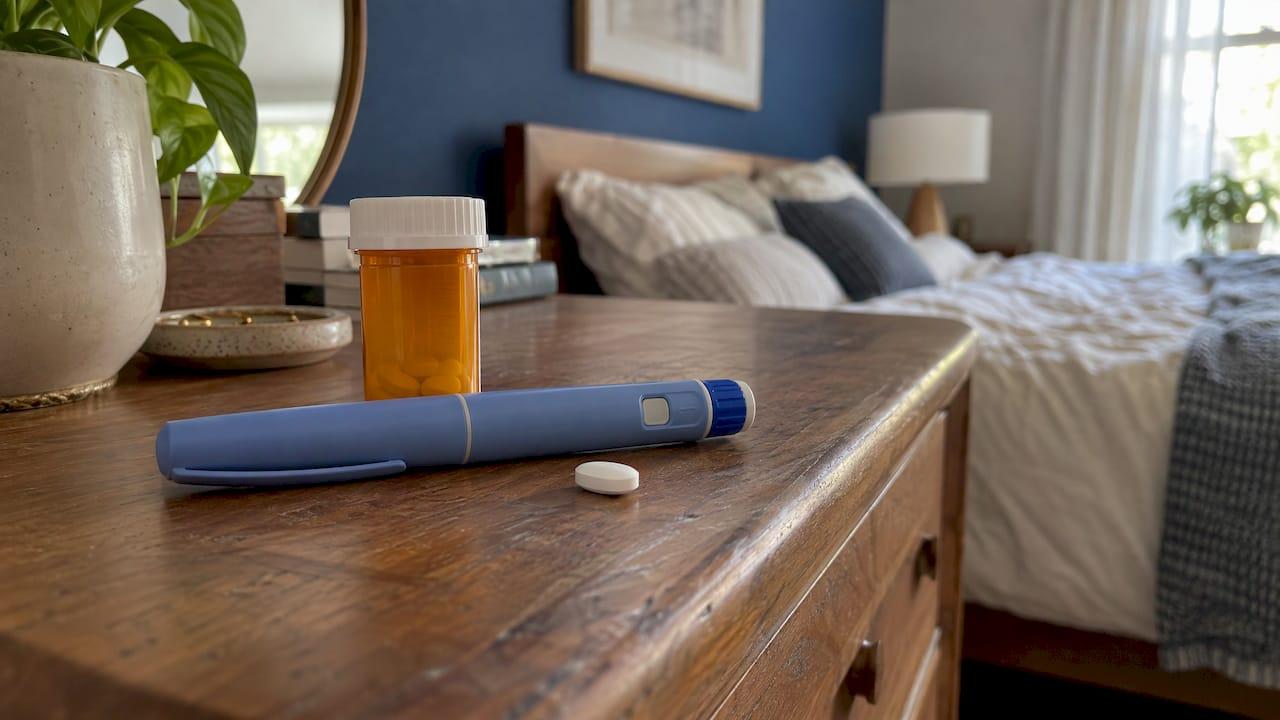
Yes, most people can take semaglutide and an SSRI together. Drugs.com lists no direct drug interaction between semaglutide and sertraline (Zoloft), and it reports the same for escitalopram (Lexapro). The points that deserve attention are overlapping stomach side effects, how semaglutide slows digestion, and keeping your prescriber informed about both medications. This guide covers each one, plus what trials show about weight loss and mood in people who take antidepressants.
TL;DR
- No direct interaction is listed between semaglutide and common SSRIs such as sertraline and escitalopram. Your prescriber still needs your full medication list.
- Both drug types can cause nausea or diarrhea, so overlap is the most common practical issue.
- In the STEP 1 trial, people on antidepressants lost 15.7% of body weight on semaglutide, compared with 14.7% for people not on antidepressants.
- Never stop an SSRI or a GLP-1 on your own. Report new or worsening low mood to your clinician right away.
- Our doctor-led GLP-1 care includes clinician oversight and dietitian consults, so your full medication list is part of the plan.
Table of Contents
- Is it safe to take semaglutide with an SSRI?
- How semaglutide can change the way oral medicines are absorbed
- Overlapping side effects: nausea, diarrhea and appetite
- Weight loss on semaglutide if you take an antidepressant
- What the research says about semaglutide, mood and anxiety
- Serotonin syndrome: what to know
- Practical steps before you start
- Our perspective
- Start personalized GLP-1 care with Dayla Health
- FAQ
- Sources
Is it safe to take semaglutide with an SSRI?
For most adults, yes. Clinicians commonly treat people who take both. A primary care physician quoted by SingleCare describes it as generally safe to take an antidepressant and a GLP-1 medication together.
The reason is how the drugs are handled by the body. According to an Endocrinology Advisor factsheet, GLP-1 agonists are broken down mainly by protease enzymes. They do not go through the liver's CYP or UGT pathways, and lab studies of semaglutide found minimal or no effect on CYP enzymes. Many SSRIs are processed through those liver pathways, so the two drugs do not compete there.

A clean interaction checker result is a good sign, but it is not a guarantee. Drugs.com itself notes that no interactions found does not necessarily mean none exist. Your clinician looks at your dose, your other medications and your history, which a database cannot do.
What the interaction checkers show
| Combination | Drug interaction listed | What else the checker mentions |
|---|---|---|
| Semaglutide + sertraline (Zoloft) | None found | A set of general warnings to review |
| Semaglutide + escitalopram (Lexapro) | None found | A minor note that SSRIs may occasionally cause significant weight loss in some patients |
Those general warnings are class-level cautions, not a finding that the pair is unsafe. Bring them to your visit if you want to go through them.
How semaglutide can change the way oral medicines are absorbed
Semaglutide slows gastric emptying, which is the speed at which food and pills leave the stomach. The Ozempic prescribing information, revised in May 2026, says this may affect the absorption of oral medications taken at the same time and advises caution. A 2026 review in PMC notes that all eleven US prescribing documents for GLP-1 receptor agonists carry similar wording.
The practical size of that effect appears small for most drugs. A 2024 systematic review in Drug Safety covered 22 reports and 6 prescribing sheets. It found that GLP-1 treatment left the peak concentration of oral drugs unaffected or lower and delayed the time to peak. It did not find clinically significant changes in total exposure. The authors concluded that dose adjustments are probably not needed for simultaneous use.
For semaglutide specifically, Drugs.com professional information reports no clinically relevant absorption effect on the oral drugs studied, including atorvastatin, digoxin, metformin and warfarin. It adds that an effect on some medicines cannot be ruled out, particularly those with a narrow therapeutic index or low bioavailability.
What this means for you:
- Take your SSRI the way your prescriber told you. Do not change timing or dose on your own to work around semaglutide.
- If you notice your SSRI seems to work differently after starting or raising a GLP-1 dose, such as a return of anxiety, mood dips or new restlessness, tell your clinician. They can review the plan.
- Tell every prescriber about every medication, including thyroid pills and other oral drugs. Our guide to semaglutide drug interactions covers the wider picture.
Overlapping side effects: nausea, diarrhea and appetite
The most common issue is not a dangerous interaction. It is stacking of side effects. SingleCare notes that semaglutide and some antidepressants, particularly SSRIs and SNRIs, can both cause nausea or diarrhea, and these may intensify when combined.
This tends to show up in the first weeks, or after a dose increase. A few habits help keep it manageable:
- Eat smaller meals. Slower digestion on semaglutide makes large, fatty meals harder to tolerate.
- Keep fluids up. Diarrhea and reduced appetite both raise the risk of dehydration.
- Keep notes. Write down when symptoms start, which medication you took and what you ate. This helps your clinician decide whether a dose change is appropriate.
- Do not skip your SSRI to feel better. SingleCare quotes a Corewell Health primary care provider who warns that abruptly stopping an antidepressant can bring withdrawal symptoms, including worse anxiety, depression and mood swings.
Contact your clinician promptly if vomiting or diarrhea keeps you from holding down fluids, or if you cannot take your SSRI because of nausea. Those are situations for a call, not for waiting it out.
Appetite is a separate point. The Drugs.com note on escitalopram mentions that SSRIs may occasionally cause notable weight loss in a small share of patients. If you eat much less than usual, tell your clinician so your nutrition stays adequate. Our dietitian consults are built for exactly this kind of question.
Weight loss on semaglutide if you take an antidepressant
Many people worry that an antidepressant will blunt semaglutide. The best randomized evidence is reassuring. A 2024 post hoc analysis in Obesity pooled the STEP 1, 2, 3 and 5 trials. Of 3,683 participants, 539 were taking antidepressants at baseline. At week 68, semaglutide produced greater weight loss than placebo whether or not people took antidepressants.
| STEP 1 group | Semaglutide 2.4 mg | Placebo |
|---|---|---|
| On antidepressants | −15.7% | −0.2% |
| Not on antidepressants | −14.7% | −2.8% |
In plain terms, people on antidepressants lost meaningful weight on semaglutide, in this analysis a similar amount to everyone else.
Observational data show a more mixed picture for particular drugs. A 2022 cohort study in PMC of 31,273 patients found smaller average weight change among people on citalopram or escitalopram alongside a GLP-1 than among those on a GLP-1 alone (0.73 kg compared with 1.74 kg). That was a retrospective look at records, not a randomized trial, and results differ by person, drug and dose. The takeaway is to track your progress with your care team rather than to expect one fixed outcome.
If you take an SSRI for years, other parts of long-term health come up at checkups too. Research on SSRI bone loss is worth reading alongside your weight management plan.
A word on which SSRI affects weight most. A 2025 meta-analysis of 26 randomized trials in BMC Psychiatry found fluoxetine was associated with an average body weight reduction of about 2.1 kg, mostly at higher doses over shorter periods. That is not a reason to switch medications. Any change to your SSRI is a decision for the prescriber who manages it.

What the research says about semaglutide, mood and anxiety
A common worry is whether a GLP-1 can worsen depression. Here is what the larger studies found.
- STEP trial analysis. A 2024 post hoc analysis in JAMA Internal Medicine found that semaglutide did not raise the risk of depressive symptoms or suicidal ideation versus placebo. Depression scores were slightly lower with semaglutide, a difference the authors did not consider clinically meaningful. Reports of suicidal ideation or behavior were 1% or fewer, with no difference between groups.
- Meta-analysis of 80 trials. A 2025 review in JAMA Psychiatry covered 107,860 patients. It found no significant difference in serious or nonserious psychiatric adverse events, or in depressive symptom change, for GLP-1 treatment compared with placebo.
- Swedish registry study. Healio reported a 2026 study in which semaglutide was associated with lower risk of worsening depression and anxiety than non-GLP-1 use. These are associations. They do not prove that semaglutide treats these conditions, and trials designed for that question are still needed.
So semaglutide is not a treatment for depression or anxiety, and it does not replace your SSRI. What the evidence supports is that, for most people, adding it does not appear to worsen mood.
The FDA's position on suicidal thoughts
The FDA reviewed reports of suicidal thoughts in people using GLP-1 medicines. In its safety communication, the agency said its preliminary evaluation found no evidence that these medicines cause suicidal thoughts or actions. It also said that because the number of events was small, it cannot definitively rule out a small risk, and it is still looking into it.
The FDA's advice is direct:
- Do not stop a GLP-1 without first talking to your health care professional.
- Report new or worsening depression, suicidal thoughts or unusual changes in mood or behavior.
If you are in crisis or thinking about harming yourself, call or text 988, the Suicide & Crisis Lifeline, or go to the nearest emergency room.
Serotonin syndrome: what to know
Serotonin syndrome comes from too much serotonin activity, usually when several serotonergic drugs are combined. Semaglutide is not a serotonergic drug, and the interaction checkers above list no interaction with sertraline or escitalopram. Still, you should know the warning signs of this condition if you take an SSRI. These include agitation, a racing heart, heavy sweating, muscle twitching, fever and diarrhea. If these appear suddenly, seek urgent medical care.
Because diarrhea is also a common GLP-1 side effect, a single symptom is usually not a cause for alarm. A cluster of symptoms that come on quickly, especially after starting a new medication, is the reason to get care at once.
Practical steps before you start
- List everything you take. Include your SSRI and dose, other prescriptions, over-the-counter products and supplements.
- Share your mental health history. Mention past depression, anxiety, or any history of self-harm so your clinician can plan monitoring.
- Keep your SSRI schedule steady. Take it as prescribed, and ask before changing anything.
- Start where your clinician advises. Dosing is individual. Our maintenance dose injection and sublingual drops are among the formats available, and your clinician decides what fits.
- Check in early. Note mood, sleep, appetite and stomach symptoms in the first weeks and after each dose change.
- Plan for the long term. If you ever want to come off treatment, do it with guidance. Our taper guide explains a clinician-led approach.
If you take other medications as well, these related guides may help: semaglutide with metformin, semaglutide and Adderall and semaglutide and hypothyroidism.
Our perspective
We see people every day who are managing more than one health goal at once. Taking an SSRI and wanting medically supervised weight loss is common, and it should not mean going without care.
The evidence supports a calm, organized approach. Direct interactions are not listed for common SSRIs, trial results show meaningful weight loss on semaglutide regardless of antidepressant use, and the main practical issue is overlapping nausea. That is a problem a clinician can help you manage.
This is why we build personalized GLP-1 care around clinician oversight, not just a shipped prescription. Your medication list, your history and your mood are part of the plan. Dietitian consults and care coaching support you between check-ins, and you can choose injection, microdose or needle-free oral delivery to match your comfort level.
Our approach is simple: transparent cash pricing, no membership fees, and flexible cancellation, so you can focus on your health.
Flexible
Start personalized GLP-1 care with Dayla Health
If you take an SSRI and want doctor-led weight loss care, start with an online intake. A clinician reviews your history and medications before any prescription is approved. Our plans are paid in cash, with no insurance required, and ship nationwide. Published monthly prices on our site start at $149 for Oral GLP · Liposomal, $159 for GLP-1 Microdose and $179 for GLP-1 Injection. The dayla GLP-1 program is $299 per month.

Each plan includes clinician evaluation, medication, care coaching and shipping, with free dietitian visits. Prescriptions depend on clinician approval.
FAQ
Does Lexapro counteract semaglutide?
No. Drugs.com reports no drug interactions between escitalopram and semaglutide. That does not guarantee that none exist for you. Tell your prescriber about both medications, and report any change in how you feel.
Can semaglutide help with anxiety?
Semaglutide is prescribed for weight management, not anxiety. A 2024 analysis of the STEP trials found a small drop in depressive symptoms that was not clinically meaningful, and no increase in psychiatric risk. A 2026 Swedish study found associations with fewer worsening anxiety events, but this does not prove cause. Keep taking any anxiety medication your clinician prescribed.
Does a GLP-1 affect antidepressants?
It can slow how fast oral pills leave the stomach, so the label advises caution with oral medications. A 2024 systematic review found no clinically significant change in total drug exposure and concluded dose adjustments are probably not needed. Report any change in how your antidepressant seems to work.
Can I lose weight on semaglutide while taking an SSRI?
Yes. In the STEP 1 trial, participants on antidepressants lost 15.7% of body weight on semaglutide, against 14.7% for those not on antidepressants. Individual results vary, so track progress with your care team.
Sources
- Semaglutide + Zoloft interaction check, Drugs.com
- Lexapro + semaglutide interaction check, Drugs.com
- Ozempic prescribing information, FDA
- Motility-mediated drug interactions with GLP-1 receptor agonists, PMC
- Drug-drug interactions between GLP-1 receptor agonists and oral drugs, Drug Safety
- Sertraline and tirzepatide interactions, Drugs.com professional
- GLP-1 interactions, Endocrinology Advisor
- Ozempic and antidepressants, SingleCare
- FDA update on suicidal thoughts evaluation
- Semaglutide 2.4 mg by antidepressant use, Obesity
- Effect of antidepressants on GLP-1 receptor agonist outcomes, PMC
- Psychiatric safety of semaglutide, JAMA Internal Medicine via PMC
- GLP-1 receptor agonists and mental health, JAMA Psychiatry
- GLP-1s and worsening mental health, Healio
- Fluoxetine and body weight meta-analysis, BMC Psychiatry
- SSRI bone loss research